

Ocean energy town hall explores Guam’s potential to harness power from the sea
Researchers, energy experts and community stakeholders gathered at the University of Guam recently to explore how the ocean surrounding the island could become part of Guam’s future energy portfolio.
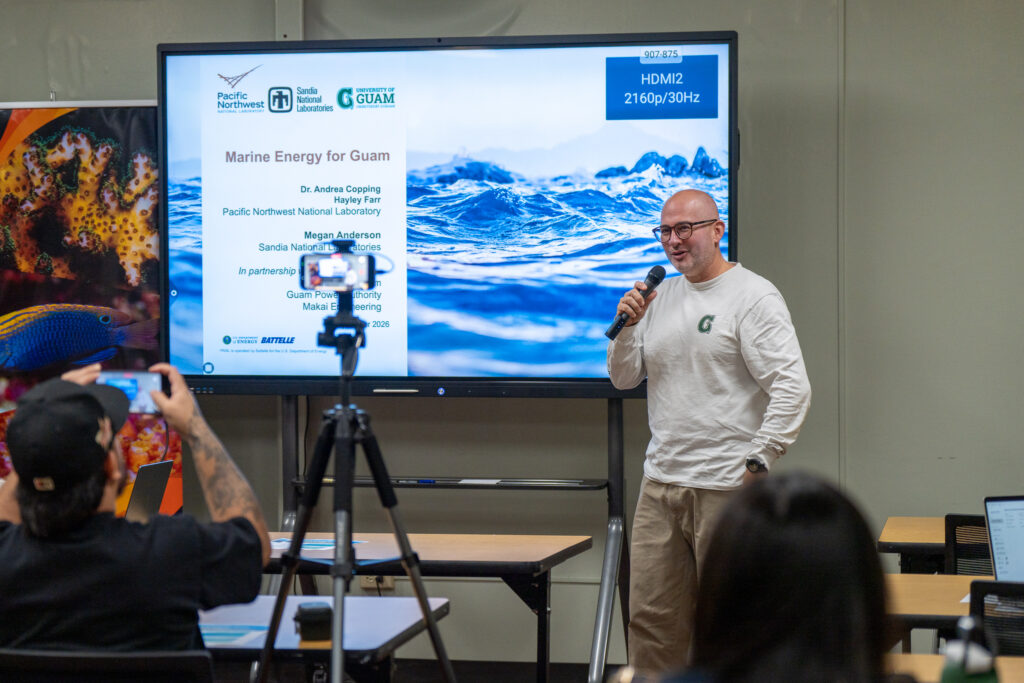
The Ocean Energy Town Hall, hosted by Pacific Northwest National Laboratory (PNNL) and the University of Guam through Guam NSF EPSCoR E-RISE program, brought researchers and members of the community together to discuss emerging marine energy technologies and their potential applications on Guam.
Among the technologies discussed were Ocean Thermal Energy Conversion (OTEC), seawater air conditioning (SWAC), and wave energy — approaches that could take advantage of Guam’s unique location and surrounding ocean resources while helping the island work toward greater energy security and resilience.
“This town hall is a great way to continue our discussion on potential ocean energy solutions for Guam,” explained Bastian Bentlage, Ph.D., the principal investigator of the Guam NSF EPSCoR E-RISE program. “We have had several of these meetings over the course of the past several years and every time, we get new information, but also useful discussion from the community.”
For Guam, the conversation has particular significance. The island remains heavily dependent on imported fossil fuels, making its energy system vulnerable to fluctuations in fuel costs, supply disruptions and natural disasters. The U.S. Department of Energy has identified Guam’s geographic isolation, dependence on imported fuel and exposure to powerful tropical storms as important energy challenges.
One of the technologies receiving attention is Ocean Thermal Energy Conversion, or OTEC.
OTEC takes advantage of the temperature difference between warm surface seawater and much colder water found deep below the ocean’s surface. That temperature differential can be used to operate a heat-exchange system and generate electricity.
Tropical locations such as Guam are particularly relevant to OTEC research because the necessary temperature differences are available throughout the year. Research associated with PNNL has identified Guam and other U.S. tropical islands as locations where year-round OTEC could be feasible.
Previous research involving UOG, PNNL and Sandia National Laboratories has already examined whether OTEC and wave energy systems could help power a proposed aquaculture ecosystem on Guam. That work evaluated not only energy generation but also infrastructure requirements, economics and potential environmental impacts.
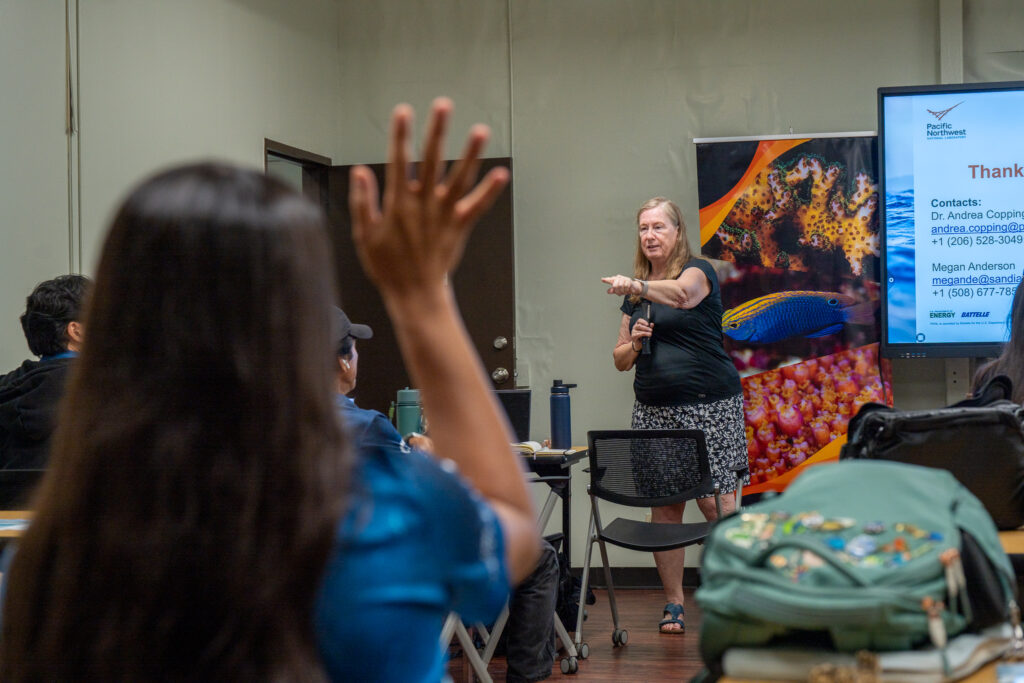
“(OTEC) generates power from temperature differentials from cold deep seawater to warm surface water,” said Andrea Copping, Ph.D. from PNNL. According to Copping, Guam is well suited for OTEC for many reasons including its compatibility with the island’s base load needs, deep ocean water accessibility, and warm temperatures above the threshold year round.
Researchers have also pointed to an important characteristic of OTEC: unlike renewable sources that depend on sunshine or wind conditions, the ocean’s thermal gradient could potentially provide a more consistent source of energy.
The town hall also explored seawater air conditioning, commonly known as SWAC.
Rather than generating electricity, SWAC uses cold water drawn from the deep ocean as part of a cooling system for buildings. The technology can reduce the amount of electricity traditionally required for air conditioning — an especially relevant consideration for tropical islands where cooling represents a significant energy demand.
Cold deep-ocean water associated with these systems could potentially have additional applications, including aquaculture and other industries.
Copping said that at this time, air conditioning accounts for 40-50% of Guam’s electric load. This could help with coastally accessible buildings where that current need is very obvious, including the hotels in Tumon.
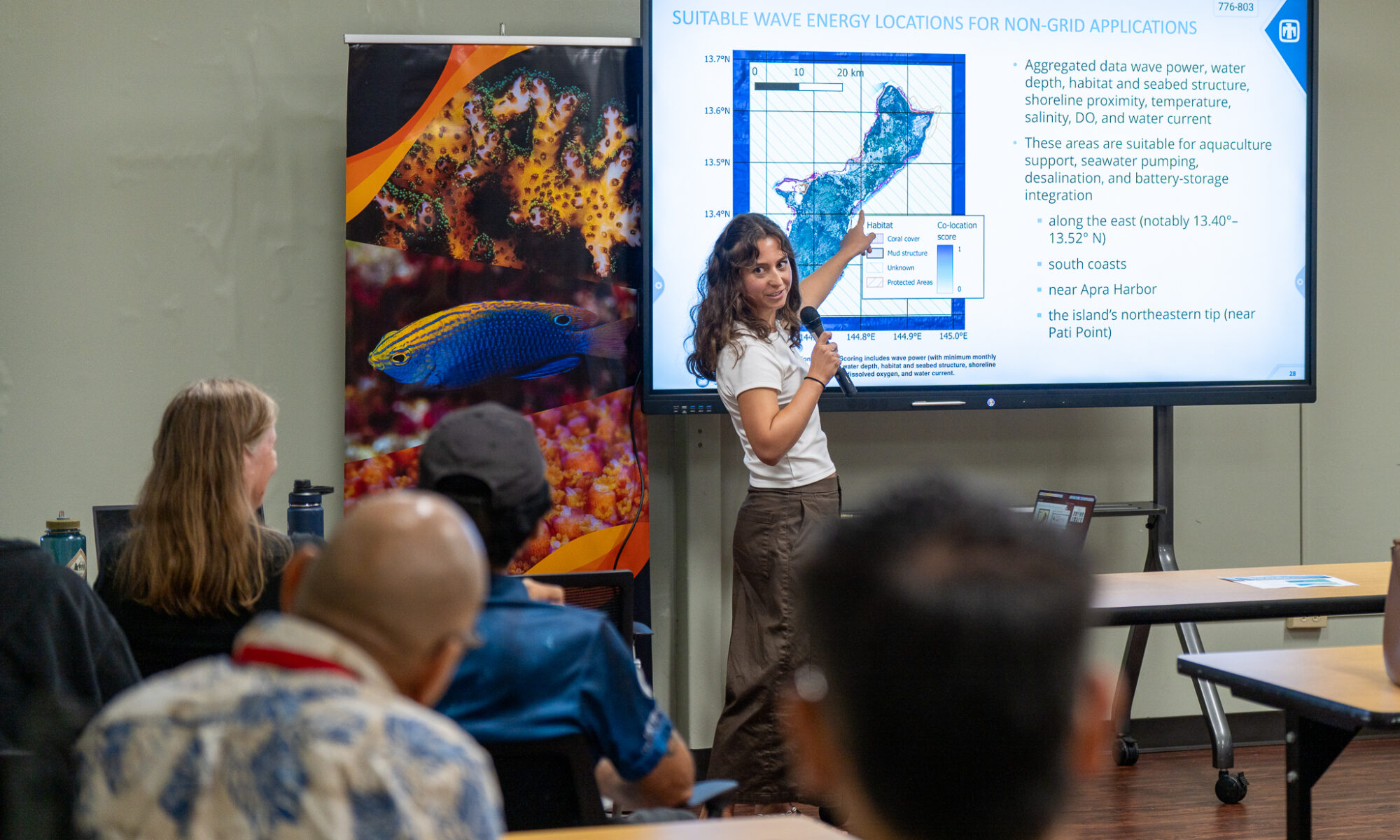
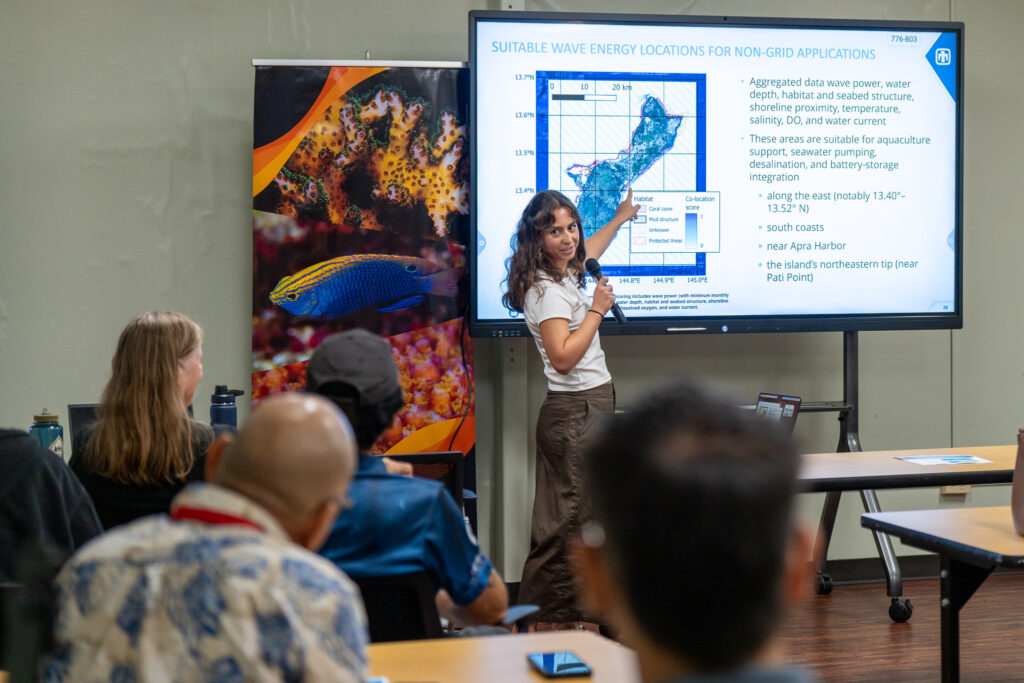
Another area of discussion centered on wave energy, which uses devices placed in or near the ocean to convert the movement of waves into usable electricity.
Marine energy technologies remain an emerging field, and researchers continue to evaluate their technical performance, cost and environmental effects before widespread commercial deployment.
For Guam, researchers have previously examined potential wave-energy applications not only as a source of electricity but to support industries such as aquaculture.
The town hall was also intended to create a conversation between researchers and the people who could ultimately be affected by future ocean-energy development.
Community engagement has become an important part of Guam’s renewable-energy research. A UOG Center for Island Sustainability and Sea Grant report released this month documented community perceptions surrounding ocean renewable energy, with the findings intended to help inform future energy planning and local decision-making.
Questions surrounding cost, environmental impacts, infrastructure, location and community acceptance will all have to be considered as researchers determine whether the technologies can move from studies and demonstrations toward practical use.
The discussion also aligns with the broader mission of Guam NSF EPSCoR E-RISE, which is working to expand Guam’s research capacity, strengthen collaboration among institutions and develop a locally trained STEM workforce capable of addressing island challenges.
While large-scale ocean energy development on Guam remains a developing possibility rather than an immediate solution, researchers say continued study can help determine which technologies make technical, economic and environmental sense for the island.