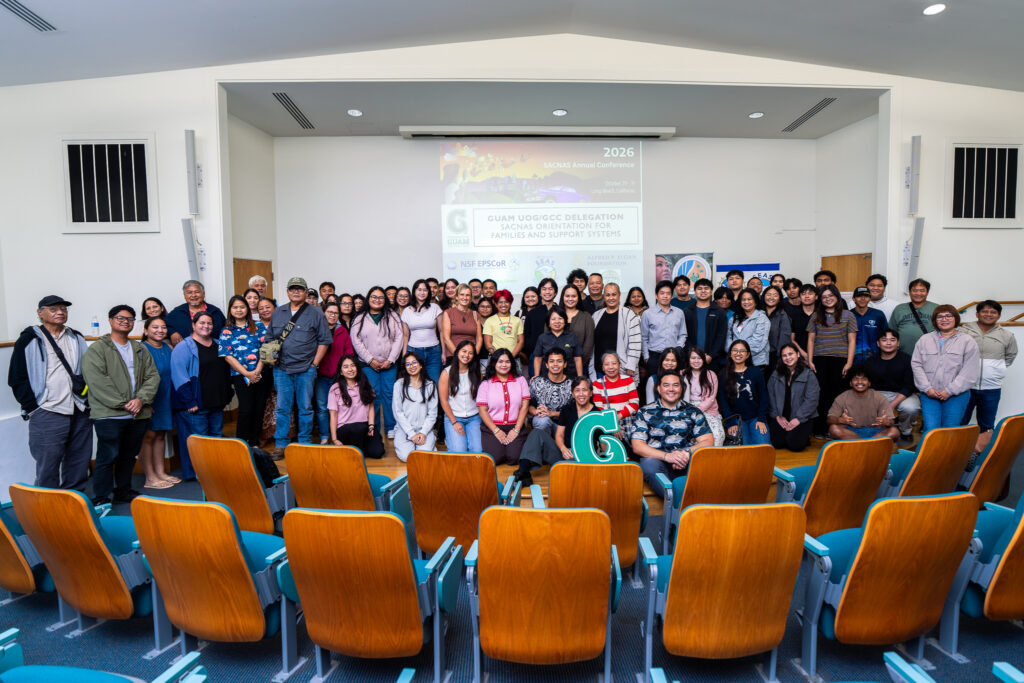
University of Guam (UOG) students will not only present their research this week at the Society for the Advancement of Chicanos/Hispanics and Native Americans in Science (SACNAS) National Diversity in STEM (NDiSTEM) Conference, but will also gain access to scholarships, internships and research opportunities, according to program leadership.
The conference runs Oct. 29 to 31 in Long Beach, California.
This year’s Guam delegation is the largest on record, with 68 participants, up from 27 in 2025. Thirty-eight are students, including those funded through Guam NSF EPSCoR, Navigating Home, NSF INCLUDES SEAS Alliance, Alfred P. Sloan Foundation, NextGen COMPASS and BES-RENEW.
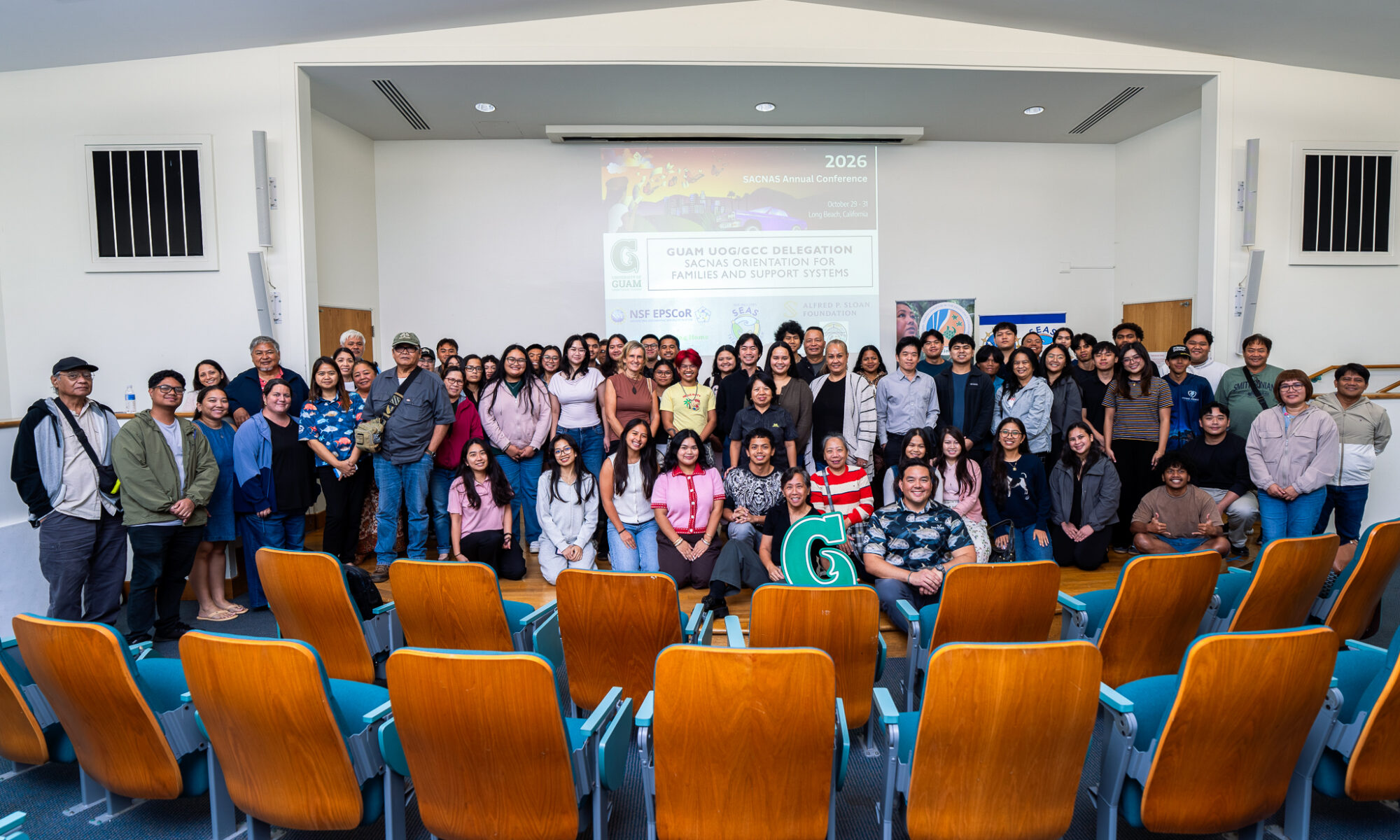
Austin Shelton, Ph.D., director of the UOG Center for Island Sustainability and Sea Grant, told students and families at a pre-departure orientation that the conference can change the course of a young scientist’s career if they use it well.
“Take advantage of every session and every break to do some networking. It’s going to set you on a new trajectory in your career,” Shelton said. He described hundreds, if not thousands, of exhibitors at the event, including colleges and universities, federal agencies such as the National Science Foundation and the U.S. Fish and Wildlife Service, and private companies.
Shelton first attended SACNAS as a graduate student on a travel scholarship. He has since served on the SACNAS national board of directors.
He told students their island experience gives them something many peers lack. “They didn’t get to grow up right next to the most diverse coral reefs in the United States or incredibly diverse forests and just everything else that we have going on,” he said.
“The reason why representation is very important in science is because you have the answers to the scientific questions and problems that maybe nobody else in the country or the world would have,” Shelton added.
One of these students is Azer Bilimon, a participant supported by EPSCoR ECORE, who will present “Sustainable Seawater-Based Cement Mortar Reinforced with Natural and Synthetic Fibers for Pacific Island Communities.” His research focuses on sustainable construction, using seawater instead of fresh water in the cement mix and coconut fiber as reinforcement to reduce the use of non-renewable aggregate. He said the work was inspired by limited access to fresh water in the Marshall Islands.
Bilimon received the Native American/Indigenous Student Research Abstract Award last year, and this will be his third SACNAS conference. He said attendees were impressed when he presented his work last year, including some structural engineering professionals. Universities from other states also took notice and wanted to know more about his research. Some offered him an internship. “Compared to the last time, I’m more confident this year. I want to share more about my research,” Bilimon said.
Cheryl Sangueza, Ph.D., a professor at the UOG School of Education who oversees SACNAS participant programs for Guam, said a total of 32 abstracts from Guam were submitted for consideration. According to Sangueza, the conference features hundreds of undergraduate and graduate poster sessions and welcomes and encourages culture and identity in science.