

SACNAS poster presentation: Rethinking rainwater harvesting for the island
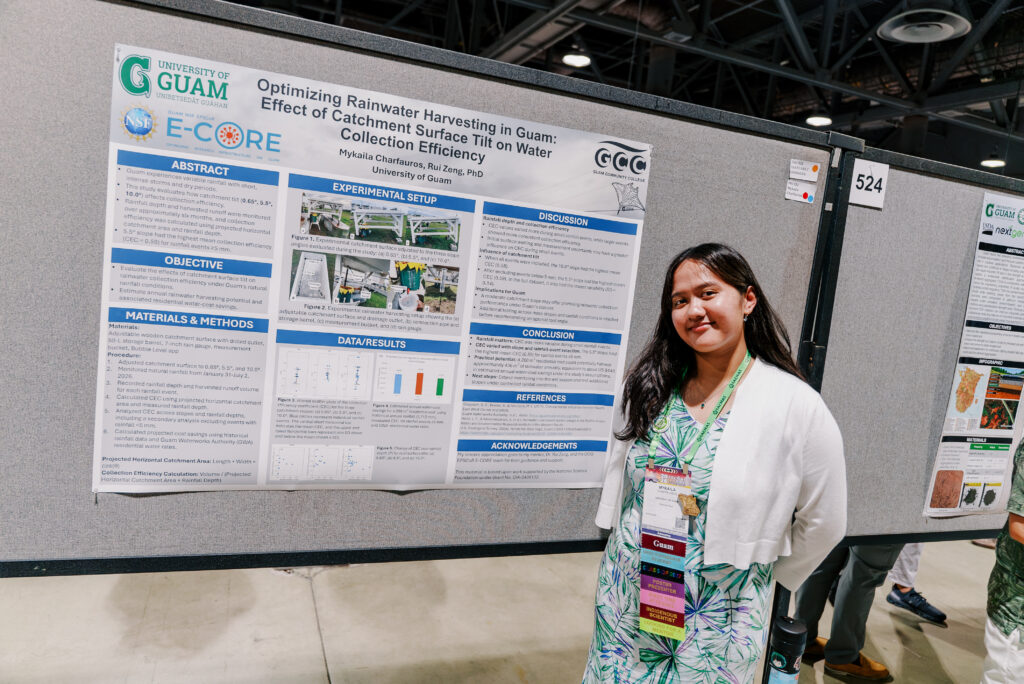
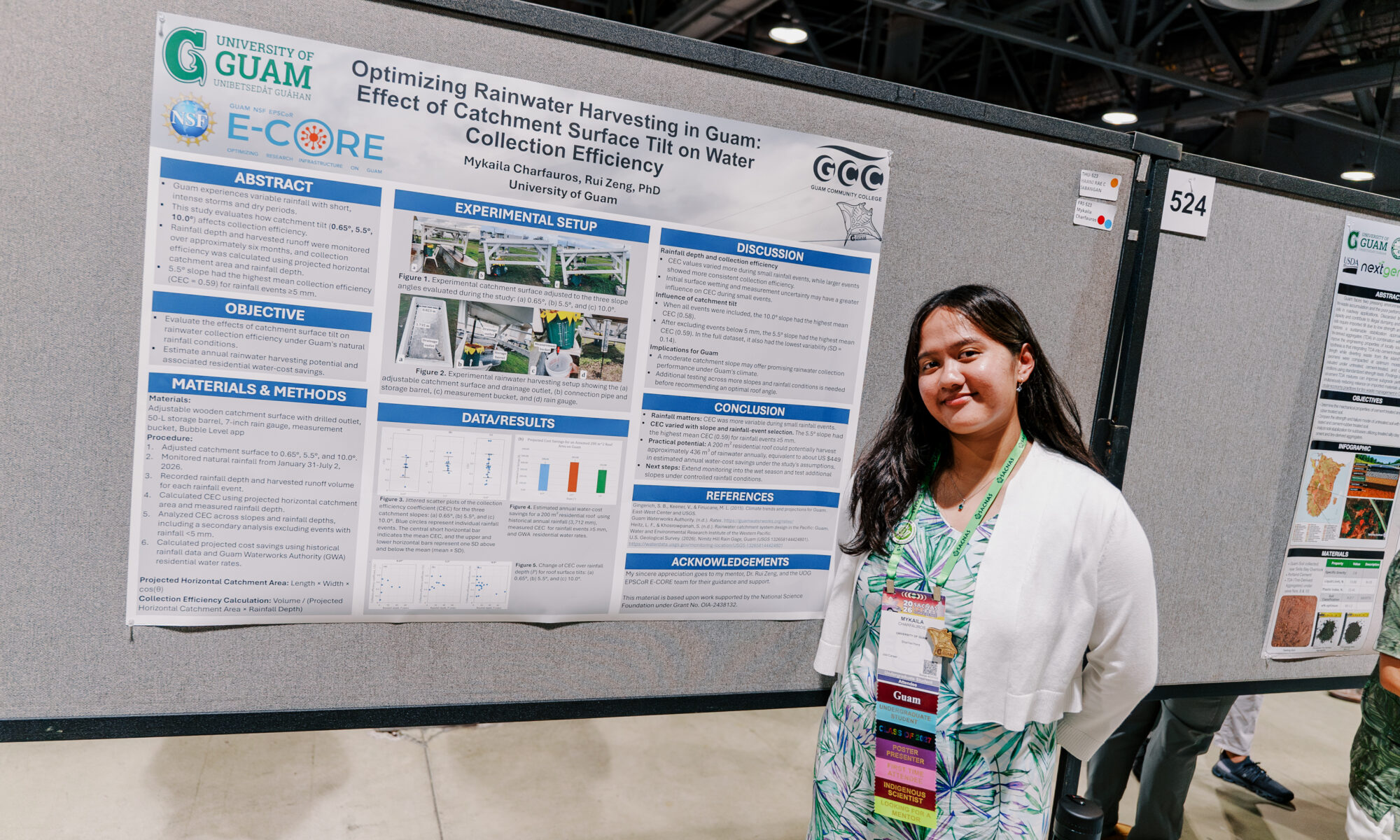
Guam’s weather is defined by contrasts: short, intense storms followed by dry spells. For researcher Mykaila Charfauros, that pattern is an opportunity. At the 2026 SACNAS Annual Conference, she presented a poster titled “Optimizing Rainwater Harvesting in Guam: Effect of Catchment Surface Tilt on Water Collection Efficiency,” developed with her mentor, UOG School of Engineering Associate Professor Rui Zeng, Ph.D. The research asks two practical questions: what roof angle captures the most rainwater, and what are the estimated annual cost savings for those with a catchment system?
Charfauros was drawn to the topic by the island’s climate and by a gap in the research. “Guam’s year-round rainfall is ideal for implementing rainwater harvesting, both commercially and residentially.” Yet no earlier research had examined this question on Guam. The takeaway she hopes visitors carry away is that “small design considerations can make a difference in rainwater collection efficiency and help communities make better use of our available natural resources.”
To test the idea, she built a simple, adjustable setup: a wooden catchment surface with a drilled outlet, a 50-liter storage barrel, a 7-inch rain gauge, and a measurement bucket. She set the surface to three tilts, 0.65°, 5.5°, and 10.0°, and monitored natural rainfall from January 31 to July 2, 2026, recording the rainfall depth and harvested runoff volume for every event. She then calculated collection efficiency (CEC) from the volume collected, the projected horizontal catchment area, and the measured rainfall depth, comparing slopes across all events and again after excluding events under 5 mm of rain. Finally, she paired historical rainfall data with Guam Waterworks Authority (GWA) residential water rates to estimate potential cost savings.
The results show that rainfall size matters. CEC varied more during small rainfall events, while larger events produced more consistent efficiency, a pattern Charfauros attributes to initial surface wetting and measurement uncertainty weighing more heavily when little rain falls. Slope mattered too, though the answer depended on which events were counted. With every event included, the 10.0° slope had the highest mean CEC (0.58). After excluding events below 5 mm, the 5.5° slope came out on top at 0.59, and in the full dataset it also showed the lowest variability (SD = 0.14).
For Guam, that points to a cautiously encouraging conclusion: a moderate catchment slope may offer promising collection performance, though Charfauros is clear that more testing across additional slopes and rainfall conditions is needed before recommending an optimal roof angle. The practical payoff could still be meaningful. Under the study’s assumptions, a 200 m² residential roof could potentially harvest approximately 436 m³ of rainwater each year, equivalent to about US $449 in estimated annual water-cost savings.
Next, she plans to extend monitoring into the wet season and test additional slopes under controlled rainfall conditions. As for the conference itself, her focus is on community: “I’m most excited to meet new people and learn about research conducted by others!”
The research was supported by the Guam NSF EPSCoR E-CORE program.
AT A GLANCE
- The big idea: The tilt of a roof can change how much rainwater it collects. This study tests which angle works best in Guam.
- What’s a diatom? Tested three tilts (0.65°, 5.5°, and 10.0°) on a small catchment surface, measuring rainfall and collected water from January to July 2026. Collection efficiency (CEC) is the share of rain that was captured.
- Key terms: Catchment surface is the surface, like a roof, that rain lands on and drains from into storage. Tilt is the angle of that surface, measured in degrees.
- What they did: The team collected marine samples, cleaned them with acid, and examined the specimens under light and scanning electron microscopes
What they found: The 5.5° tilt collected best for rainfall events of 5 mm or more (mean CEC of 0.59). Small rain events gave less consistent results.
What it means: A moderate slope looks promising, but more testing is needed. A 200 m² roof could harvest about 436 m³ a year, saving roughly US $449.
Acknowledgments
The material for the poster is based on work supported by the National Science Foundation under grant number OIA-2438132.