

EPSCoR E-RISE cultural workshops: Lessons beyond the lab
How do you study an island’s reefs, fisheries, and marine resources without first knowing its story? That was the idea behind a weekend session at the University of Guam, where graduate researchers traded lab talk for lessons in CHamoru language, dance, and traditional seafaring practices.
The Guam National Science Foundation Established Program to Stimulate Competitive Research (Guam NSF EPSCoR) Graduate Research Assistant (GRA) program is open to students pursuing their master’s degree at UOG. The EPSCoR E-RISE (Research Incubators for STEM Excellence) project specifically supports students interested in marine biology and ecosystem research, a field of great interest to many students from abroad.
Because the GRA program often comprises students who are not from Guam, the cultural seminar was held to help them connect with the island where they conduct their research.
Held at the UOG School of Education on Saturday, October 10, the cultural seminar and workshop was organized by Christina Mantanona, graduate research mentor for Guam NSF EPSCoR E-RISE, with guidance from Cheryl Sangueza, Ph.D., co-principal investigator for Guam NSF EPSCoR E-CORE. Heading the presentation was Siñot Frank Rabon, master of CHamoru dance and founder of Guma’ Taotao Tåno’, and Saina Ron Acfalle, traditional canoe builder and navigator.
Sangueza conducts Near Peer sessions for participants in both the EPSCoR E-RISE GRA and E-CORE SRE (Student Research Experience) programs, which bring researchers together to bond and share insight on how their work is going. With this being the first seminar for this year’s cohort, Mantanona wanted the GRAs to be able to connect with their environment in a cultural rather than scientific viewpoint.
“We wanted to focus on how they can approach their research from a very, you know, Guam first point of view,” Mantanona said. “How they can do their research on Guam while always putting the island first, the local language first, and really learning how to become great stewards of the land.”
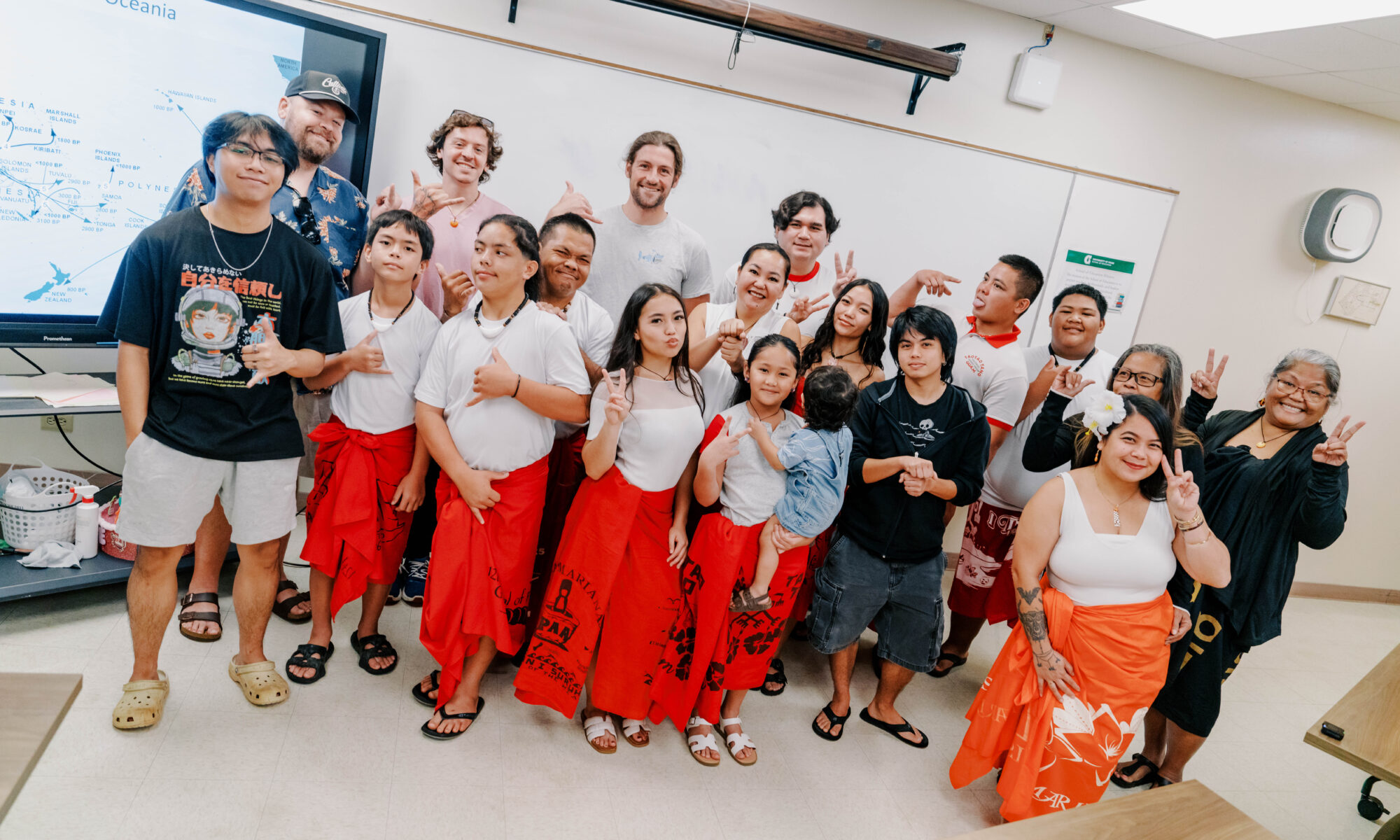
Siñot Rabon gave a brief presentation on the history of Guam, touching on CHamoru language, dance, migration, colonization, and the overall history of the culture and its changes throughout the years. Members of Rabon’s cultural dance group Guma’ Taotao Tåno’ were also in attendance, giving a short dance presentation and sharing the meaning behind some of their moves.
Saina Acfalle described the nature of traditional seafaring, touching on how he learned to sail and build canoes. Acfalle also spoke on his most recent voyage – an almost two-month adventure from Guam to Taiwan and back with a crew of 42 aboard a 30-foot double hull canoe.
Joe Elper, E-RISE GRA studying fisheries management under Michalis Mihalitsis, Ph.D., was able to connect the cultural information from the seminar to his own research. In his view, good fisheries management naturally connects to how the island’s ancestors fished sustainably and how those practices have endured. He said that link carries more weight than a marine lab professor simply declaring the right method.
“This is the proper way to do it,” Elper said.