G3 Conservation Corps assists with post-storm campus cleanup as UOG starts Finakpo session

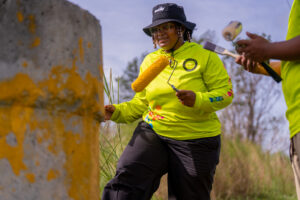
Members of the Guam Green Growth Conservation Corps carrying a tree branch.

G3 Conservation Corps assists with post-storm campus cleanup as UOG starts Finakpo session

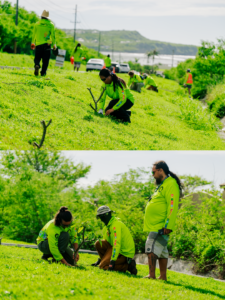
Members of the first Guam Green Growth (G3) Youth Conservation Corps and the 2026 cohort of the G3 Conservation Corps responded to post-typhoon recovery efforts, removing debris and clearing storm-damaged areas at the University of Guam (UOG) and partner sites after Super Typhoon Bavi passed through the Marianas. 

Once the Governor of Guam issued the all-clear and UOG reopened the campus, the two conservation corps began cleanup and recovery activities in support of efforts headed by UOG Facilities Management and Services (FMS). 

“Although Guam was spared a direct hit from Super Typhoon Bavi, the storm still left a path of destruction. As soon as it was safe to return, our G3 Conservation Corps members stepped up to help restore the campus and support our partners. This is what community looks like: young people serving their island, gaining hands-on experience, and helping Guam recover together,” said Austin Shelton, Ph.D., director of the UOG Center for Island Sustainability and Sea Grant (UOG CIS & Sea Grant). 

According to Tomas Benavente, G3 Youth Conservation Corps program coordinator, participants began early, working on the UOG campus and at the Guahan Sustainable Culture Food Resiliency Hub in Yona. 

“The corps removed fallen tree branches and other storm debris that posed safety hazards. They also added green waste to compost piles, where it will eventually be processed into compost and mulch to support the gardens and advance the program’s sustainability goals,” Benavente said. 

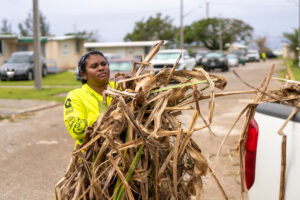
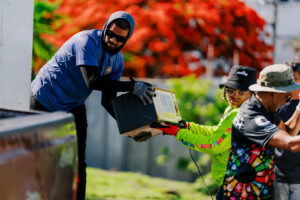
G3CC member carrying downed tree debris.
Along with work at the UOG campus, the group also worked with local group Guahan Sustainable Culture to help with recovery efforts at their food security hub.  

FMS and the Corps worked to prepare the Mangilao campus which officially welcomed students of the Finakpo Session C back to class on July 8, 2026.

G3 Conservation Corps member Abcde Tapia described seeing the significant damage caused by the typhoon, including large trees that required heavier equipment to remove. Despite the destruction, she expressed hope that the community and campus will gradually recover. “Slowly but surely, I hope and see that we will recover from this.”

That same spirit of service was shared by members of the G3 Youth Conservation Corps. Alana Kahele said, “The storm was very hard on our people, so I’m really happy to be able to help and lend a hand wherever I can.” 

Dionne San Nicolas, another youth corps member, added, “I feel really good, and I’m glad that I’m helping the community recover after the storm.”

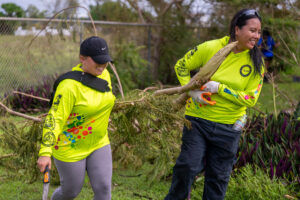
Guam Green Growth Youth Conservation Corps member carrying downed tree debris.
Guam Green Growth Youth Conservation Corps members worked along side their counterparts in the original G3CC in assisting the UOG FMS team in campus recovery efforts in the wake of Super Typhoon Bavi. 

G3 and UOG CIS & Sea Grant launched the first G3 Youth Conservation Corps to introduce high school students participating in the Governor’s Summer Youth Employment Program to careers in sustainability and the green economy. The initiative expands the G3 Conservation Corps workforce development program, now in its sixth season, by creating opportunities for younger participants to gain hands-on experience in sustainability, conservation, agriculture, aquaculture, renewable energy, and environmental stewardship. 

Since joining the program last month, Maggie Guzman said the experience has been rewarding. “I’m not usually the type to spend a lot of time outside, but honestly, I think this has been a great experience.” 

Throughout the program, members of the G3 Youth Conservation Corps and the G3 Conservation Corps will work alongside partner agencies and organizations, developing practical skills that can lead to future educational or career opportunities while addressing sustainability challenges through hands-on learning, mentorship, and community service.

G3CC x Biosecurity​

G3CC x Biosecurity

From the lab to the hives and our ports of entry, the Guam Green Growth Conservation Corps has been hard at work learning what it takes to defend our island’s ecosystem from invasive species and biosecurity threats. 🌿🐝

Here’s a look at what the team got into:

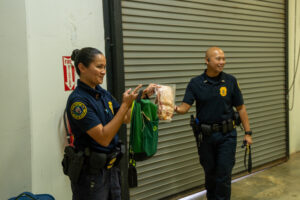
First Line of Defense: Learning from the best at Guam Customs and the Detector Dog Unit about how dangerous agricultural products and biosecurity risks are intercepted at our borders. 🐾🛄

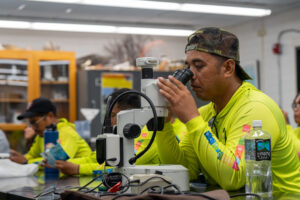
Microscopic Precision: Diving deep into specimen identification to catch invasive threats early. 🔬

Sweet (and Safe) Sustainability: Suiting up for local apiculture! The corps got hands-on experience with honeybee hive maintenance, learning how to safely manage and protect our essential pollinators. 🍯🐝

Biosecurity is a team effort, and equipping our local conservation leaders with these skills ensures a more resilient, sustainable future for Guam.

Huge thanks to all our partners who shared their expertise with the corps this week! 🙌🏽

A Closer Look: G3CC Island Beautification Tour – Tamuning

Picture of the G3 Conservation Corps at the Island Beautification event in Tamuning.

A Closer Look: G3CC Island Beautification Tour - Tamuning

True leadership isn’t defined by the strategies we write on paper; it is proven by the work we are willing to do when our community needs us most. 

Looking at these moments from our recent Guam Green Growth Conservation Corps Village Beautification, we are reminded that sustainable progress requires a profound willingness to get our hands dirty. True resilience isn’t passive. It’s an active, daily choice to show up, clear the debris, and build back stronger.

When we look at the systemic challenges facing our environments and communities today, it is easy to get lost in high-level policy and long-term targets. But as we work side-by-side moving heavy debris, sorting materials, and restoring our local spaces, a fundamental truth became clear: global goals only succeed through localized, boots-on-the-ground execution.

Sustainable development isn’t just about preserving what we have; it’s about establishing a circular, resilient mindset that can weather any storm. It’s about looking at a pile of waste and seeing a logistical challenge to be solved, or looking at a blocked pathway and seeing an opportunity for community renewal.

No titles, no egos—just a shared vision for a greener, more sustainable future, one heavy lift at a time.

Leadership is a action verb. Let’s keep moving forward.

UOG recruiting members for the sixth season of the Guam Green Growth Conservation Corps

G3CC

The University of Guam Center for Island Sustainability and Sea Grant (UOG CIS & Sea Grant) are happy to announce that applications are now open for the sixth season of the Guam Green Growth Conservation Corps (G3CC), continuing their robust workforce development plan that has graduated nearly 100 local workers who have developed skills for the emerging green economy.

The G3CC offers participants hands-on experience in conservation, sustainability, and climate-related projects that support Guam’s natural resources while building job-ready skills. Since its launch, the program has served as a pathway for residents of all backgrounds and ages to gain practical training, professional mentorship, and paid service opportunities aligned with Guam’s green economy goals.

“The G3 Conservation Corps is our flagship workforce development program preparing local workers for careers in the green economy. Its success has led to expansion into four additional companion programs,” explained Austin Shelton Ph.D., the director for UOG CIS & Sea Grant. “This Corps is a great launchpad for a new career path, a refresher, or for you to work on something you are already passionate about in sustainability. We invite all interested community members to apply today.”

Members of the Conservation Corps work on projects that may include watershed restoration, invasive species management, circular economy, food security efforts, aquaculture, agriculture, and community education. The program emphasizes leadership development, teamwork, and civic engagement, preparing participants for future careers in environmental fields.

Annania Nauta Kemp, the lead for the community engagement program has seen great results in past cohorts and looks forward to further growth for the island community.

“We have had people join straight out of high school who are now very comfortable in their career path thanks to the network and experience this program builds,” explained Kemp. “At the same time, we have retirees who are ready for their next adventure and accountants who just wanted a change of scenery come out of the program very well, too. If you feel the call to serve your community and are ready to learn and get down in the dirt with us, this can be a great way for you to shape your future.”

Now entering its sixth cohort, the program reflects growing interest and sustained momentum in Guam Green Growth’s broader mission to balance economic development with environmental protection and social well-being.

“This program really changed my perspective on sustainability and how we can make things better for our people of Guahan,” said Joseph Certeza, a G3CC Season 1 graduate who now works as a part of the program team. “This program taught me a lot, and helped me to gain not only the skills, but also the confidence to move forward in the eras of my life.”

Applications for the sixth cohort are open now and available online at GuamGreenGrowth.com. Interested applicants are encouraged to apply early and review eligibility requirements and program details on the website.

Selected team members will receive a bi-weekly stipend of $1300 and continuing education credits from the University of Guam through the Global Learning and Engagement program. Applicants must be 18 years or older, open to indoor and outdoor work, and able to work full-time at 40 hours a week.

To apply for the Guam Green Growth Conservation Corps and to learn more about other G3 initiatives, visit GuamGreenGrowth.org.

Graduates of UOG’s G3 Kupu Conservation Corps challenged to make a difference

G3CC

The fifth cohort of the Guam Green Growth Kupu Conservation Corps (G3CC) closed out their journey with a challenge: to take the lessons learned over the past six months and leave a mark, no matter what industry or path they choose next.

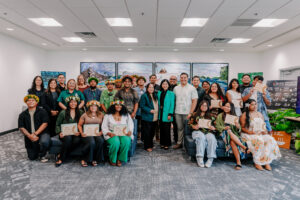
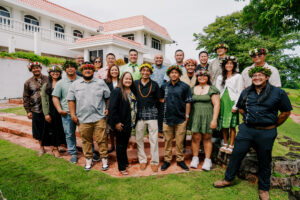
The Guam Green Growth initiative, which is facilitated by the University of Guam Center for Island Sustainability and Sea Grant (UOG CIS & Sea Grant), held a completion ceremony this month at the Government House in Agana Heights. For the first time, the Conservation Corps received certificates not only from UOG but also from the Governor’s Office, the Guam Legislature, and representatives from the Mayors’ Council of Guam.

“Make an impact,” Austin Shelton, Ph.D., director of the UOG CIS & Sea Grant, urged the cohort to make their careers more than just jobs.

“Whether you go into specific green economy jobs or go back to some of the industries that you came from— in the business sector, in HR, in administrative work, the food and beverage industry, or in the tourism industry—whatever you choose, you now have a special set of skills that are going to transform you for the rest of your lives but also transform our island,” he said.

UOG Senior Vice President and Provost Sharleen Santos-Bamba, Ph.D., highlighted how past graduates are already driving change across Guam.

“We have past graduates who are in government, in the private sector, who are entrepreneurs, or who have gone on to advance education,” Bamba said. “What that tells me is that they took those experiences and that knowledge and are now circulating it in those different spaces. So keep that in mind as you take your next steps forward,” she told the corps.

Lieutenant Governor Joshua Tenorio applauded the support of the families of the members who he hoped got to share in the experience.

“I hope that as we celebrate you in front of your families, that they get a little bit more understanding of what you’ve been doing,” said Tenorio. “I think that at the end of the celebration, they’re going to take away a lot of pride knowing that their loved one is on a mission and with a purpose to make Guam better.”

Season 5 class-elected speaker Eyana Pereda shared how the program reshaped her perspective.

“It’s one thing to know about an issue and care about it … but nothing compares to being a part of [a solution to the problem] firsthand,” Pereda said. She recalled her G3CC experience assisting in sorting of waste—she said this is where the constant influx of waste revealed “the reality of our broken system.”

The experience, she said, made her rethink how she consumes and disposes of trash daily. “What was the great thing about being a part of this corps? We were brought onto this team to work towards a better Guahan,” Pereda said.

G3 Kupu Conservation Corps Season 5 Graduates:

  1. Christian Arriola
  2. Curtis Robert Bukikosa
  3. Joshua Cepeda
  4. Marrae Cruz
  5. Mi’yah Max
  6. Eyana Pereda
  7. Matthew Pangelinan
  8. Nicolas Quinata
  9. John Reynold
  10. Gideon Tyquiengco
  11. Carl Del Rosario
  12. Tristan Ruway

Kyle Mandapat, MBA, associate director for communications and community engagement at UOG CIS & Sea Grant, emphasized the program’s growing momentum.

“This program has been going for five seasons strong thanks to the support of our legislature, the governor’s office, and UOG leadership,” Mandapat said. “Today, about 85 percent of our graduates have moved into green economy jobs or have returned to higher education.”

According to Mandapat, G3 hopes to launch recruitment for the sixth season this December. Mandapat credited the hard work of the UOG CIS & Sea Grant Community Engagement Team, led by Annania Nauta-Kemp, and the amazing line of community partners and host sites with the continued success of the program.

Upon completion, participants received a stipend and the opportunity to earn up to 80 continuing education units (CEUs) from UOG Global Learning and Engagement. They also gained hands-on experience with a wide range of environmental organizations and initiatives across Guam and the broader Micronesia region.

More information about the work of season five and the upcoming sixth season can be found online at guamgreengrowth.org.

UOG’s Guam Green Growth and Yoña mayor’s office team up for cliff side tree planting project

G3CC

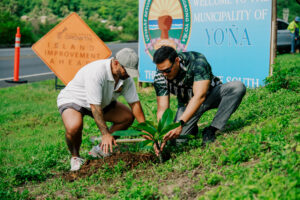
In the spirit of community collaboration, the University of Guam’s (UOG) Guam Green Growth (G3) initiative and the Yoña mayor’s office planted 34 plumeria trees along the Yona cliff line as part of ongoing island beautification efforts.

Members of the G3 Conservation Corps, the G3 GROW Corps, community volunteers along with Mayor BJ Terlaje and his team, aimed to enhance the natural beauty of the area with the planting.

“I’ve always dreamed of Yona being the gateway to the South, where you’ll see all these plumeria trees blossoming,” Terlaje explained to volunteers. “What you’re doing is a positive thing. We’re opening up the eyes and ears of our community that has been stagnant for a very, very long time.”

Participants carefully selected and planted each of the plumeria trees, a species known for its fragrant blossoms and resilience, which are well-suited for Guam’s climate.

Austin Shelton Ph.D., the co-chair of the G3 steering committee and the director of the UOG Center for Island Sustainability and Sea Grant reflected on the lasting impression and impact the planting will have for the community.

“A sustainable future is a beautiful future. We’re grateful to the hardworking volunteers who planted these trees as a stunning and fragrant legacy for our community and visitors to enjoy,” said Shelton.

The newly planted plumeria are expected to grow and flourish, providing a lasting, fragrant landscape.

Over the course of the G3 Conservation Corps’ six-month program, they will have hosted island beautification events in every village on Guam. Successful events have included roadside and beachside trash cleanups, illegal dumpsite restoration, bus stop and facility paintings, tree plantings and more.

More information on the Corps and other G3 implementation projects can be found on www.guamgreengrowth.org and via @guamgreengrowth on social media.

G3CC Dives into Fisheries Management at Week-Long Workshop

A close-up of man holding small glass slide containing a tiny specimen.

G3CC

The Guam Green Growth Conservation Corps (G3CC) went fishing for new skills with the experts from the University of Guam Center for Island Sustainabilty & Sea Grant (UOG CIS & Sea Grant), diving into the biological and cultural aspects of sustainable fisheries.

UOG CIS & Sea Grant’s Fisheries division lead the workshop, with Leilani Sablan-Naden helping to guide the G3CC along with way.

“The goal was to demystify life history research, empower community members with scientific skills, and highlight how understanding fish biology supports sustainable harvesting practices,” said Sablan-Naden.

She added, “Each day centered on a focal species or method and emphasized the important role that human behavior, tradition, and stewardship play in fisheries sustainability.”

Being a beliver in “learning by doing”, Sablan-Naden set out to teach the G3CC about the concept of life history, which is the study of an organism’s age, growth and reproduction and how this information lends itself to responsible fisheries management.

This was achieved through both lab and field work, with with lab activities like dissection of fish species to determine its sex and extracteing otoliths or “ear bones” of fish to determine its age; and field work ranging from learning traditional fishing methods like use of a talåya’ net at Tumon Bay to seeing thriving fish species swimming amidst healthy coral at places like Fish Eye in the village of Piti.

Although these activities are certainly scientific in nature, Sablan-Naden finds them necessary to showcase the accessibility of crucial information regarding Guam’s fish species while also being imperative to sustainability management.

Mi’Yah Max, a member of the G3CC’s fifth cohort participated in every aspect of the UOG CIS & Sea Grant’s week-long fisheries workshop.

Max expresses excitement in having the opportunity to work with the knowledgable and passionate fisheries team. However, unlike her fellows in the G3CC, she approached this week with some hesitation.

She says, “I’m not the best swimmer, so at first I was not as excited for this week like others in my cohort were. That is, until I caught my first fish!”

For Max, in addition to learning about the science and skills of sustainable fisheries, the week was also a lesson in perseverance and courage to try something new.

“Often times people don’t think something is possible for them, until the moment they try and it works out”, she shares. “It was my first time casting a rod and reel, so imagine my surprise when I ended up catching three fish! I am now on the look out for the best fishing rod for my next try.”

As the week with the UOG CIS & Sea Grant fisheries team drew to an end, Max reflected on the lessons learned and its place within sustainability, finding its importance to be even more dire for Guam and other island communities.

She says, “Even if I never go fishing again, I still have the basic understanding that whatever happens on the land affects the ocean, and whatever happens in the ocean affects the land.”

G3CC catches snakes and new skills at invasive species training

John Reynold wearing a lime green hood and a red headlamp looking upward at night.

G3CC

The Guam Green Growth Conservation Crops (G3CC) went scouting for snakes with the National Park Service and community group, Friends of Islan Dåno, learning how to track, capture and dispose of invasive brown tree snakes that have slithered throughout Guam.

Also known as Boiga irregularis, the brown tree snake continues to have adverse effects on Guam’s ecosystems, specifically ravaging Guam’s native bird population to near extinction.

With National Park Service taking the lead at Asan Beach Park on one night, and Friends of Islan Dåno leading the training in the village of Malesso’ on another, the G3CC received comprehensive training imperative to the removal of this sly snake species.

The team learned to properly bait and set snake traps, helping to lay around 64 at Asan Beach Park; how to track the presence of brown tree snakes by assessing availability of its food sources in a given area (e.g. cane toads, mourning geckos, and bird species), common areas and conditions brown tree snakes inhabit, and extermination.

Although mitigation of invasive species like the brown tree snake has been a challenge for Guam, learning fundamental skills on how to track and remove them is key to protecting the future of the island’s native beauty.

Armed with the knowledge shared by sustainability partners like National Park Service and Friends of Islan Dåno, the G3CC is now in a better position to meet this challenge, protecting our native species today so the people of Guam can continue to enjoy them in a distant tomorrow.

G3CC marches toward sustainability at 81st Liberation Day Parade

G3CC lean over edges of bright blue container filled with thousands of crushed aluminum cans

G3CC

The Guam Green Growth Conservation Corps (G3CC) and the G3 GROW Corps worked together with the Governor’s Office and iRecycle to bolster recycling efforts at the 81st Guam Liberation Day Parade with the mission of keeping aluminum cans out of the landfill. 

In preparation for the big community celebration, the G3CC and GROW Corps spent the week leading up to the event preparing several can bins made from chicken wire and distributing them throughout the parade route, making it easier for celebrants along Marine Corps Drive to join in on the recycling efforts.  

On the morning of the 81st Liberation Day Parade, the G3CC were on scene in Hagåtña bright and early, ready for the big day and determined to collect as many aluminum cans as possible.  

At the day’s end, the G3CC, GROW Corps and iRecycle managed to collect 20 55-gallon trash bags filled with aluminum cans, totaling approximately 4,500 cans diverted from the landfill. 

With the cans from the parade collected, they will be distributed to iRecycle bins housed at various public schools throughout Guam, with the funds raised from each recycling bin going to each school.  

For the G3CC’s fifth season and GROW Corps first season members, the mission to mitigate the impact of recyclable waste sent to the landfill through recycling was a success, through collaboration with sustainability partners like the Office of the Governor of Guam and iRecycle, and the island community at large.  

UOG to distribute free can bins and support recycling at 81st Guam Liberation Day Parade

G3CC

The University of Guam’s Guam Green Growth Conservation Corps (G3CC) announced its plans to promote environmental stewardship and enhance recycling efforts at the upcoming 81st Guam Liberation Day Parade by distributing free can bins to parade attendees and aiding with aluminum can recycling along the parade route.

Alongside partners iRecycle, this initiative aims to empower the community to participate actively in waste reduction and proper recycling, contributing to a cleaner and more sustainable Guam. The Liberation Day Parade, one of the most attended events of the year, generates a significant amount of recyclable waste, particularly aluminum cans.

By providing convenient recycling solutions, the group hopes to keep these materials from the landfill and foster a culture of environmental responsibility.

“This is the biggest event of the summer and G3 is ready to do our part to help with the celebration,” said Austin Shelton Ph.D., director of the University of Guam Center for Island Sustainability and Sea Grant (UOG CIS & Sea Grant). “Our team will be working hard to help parade goers divert these cans from the landfill and onto iRecycle where they will be donated to schools to raise money to support their students.”

G3CC members and team members from the UOG CIS & Sea Grant will be moving along the parade route to distribute the reusable can cages, which are designed to make collecting aluminum cans simple and efficient for families and groups enjoying the festivities. They will also guide attendees on where to deposit their collected cans for proper recycling.

“UOG is proud to support the festivities in celebration of Liberation Day,” said Anita Borja Enriquez D.B.A, president of the University of Guam. “We cannot wait to see everyone out there enjoying the parade and helping them to protect our resources and keep our island beautiful through these sustainability efforts.”

The Guam Green Growth initiative encourages all parade-goers to take advantage of these resources and join in the effort to make the 81st Guam Liberation Day Parade the most environmentally friendly yet. This effort aligns with G3’s broader mission to advance sustainable development goals across the island.

Skip to content