RECAP: Guam Green Growth Conservation Corps week fourteen and fifteen
PLUG IT IN: Guam Green Growth Conservation Corps member Jackie Jones works to re-wire a lighting fixture at John F Kennedy High School. The Group spent the past two weeks replacing fixtures and installing solar panels after lessons on renewable energy.
WEEK IN REVIEW: WEEK 14-15
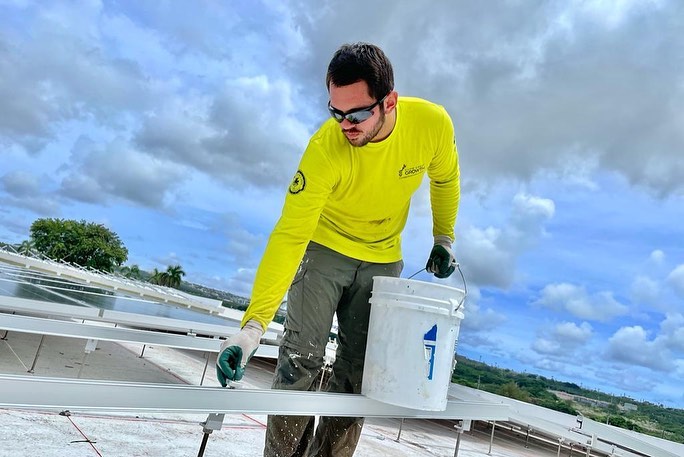
For the last two weeks, our G3 Conservation Corps has been hard at work at JFK High School!
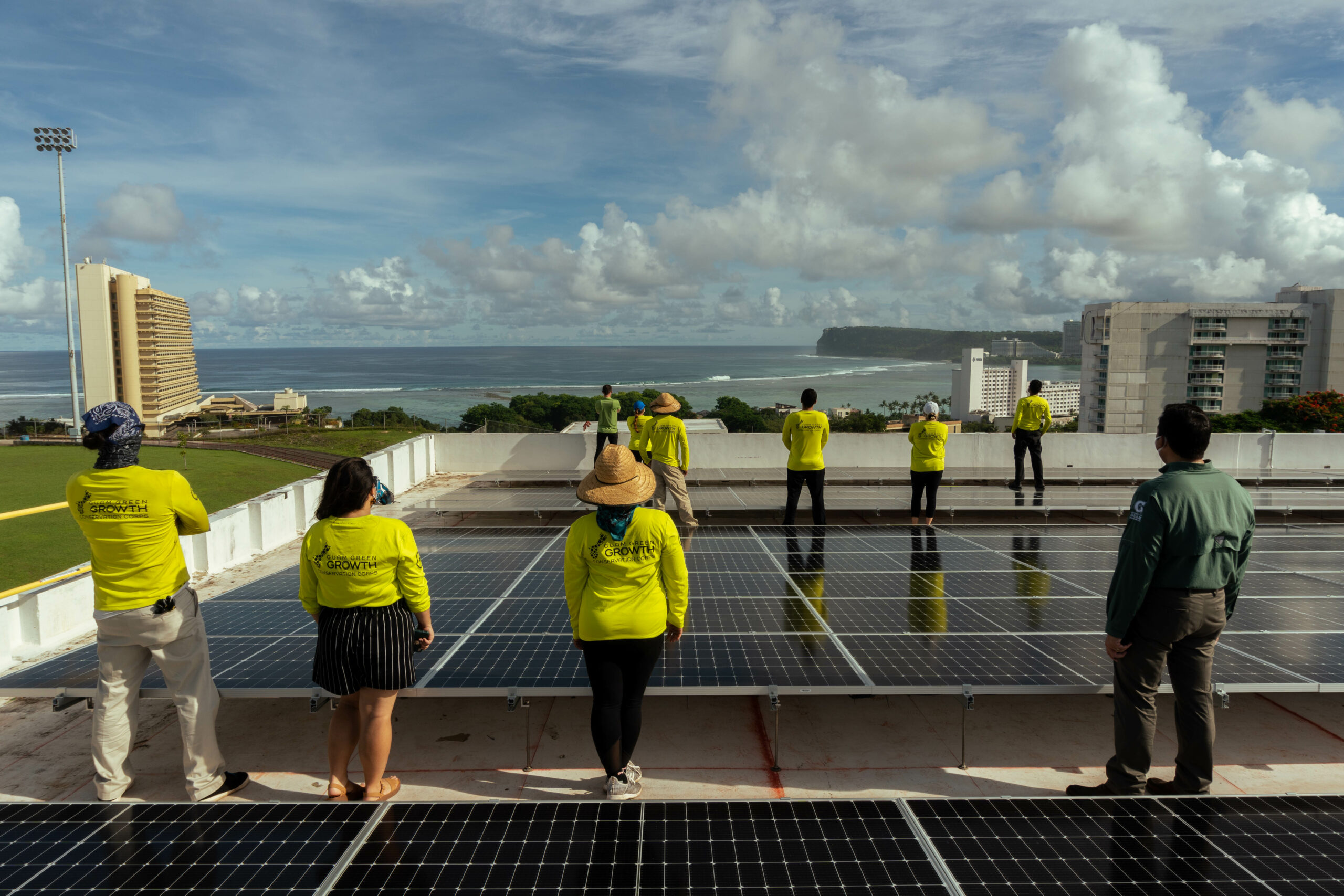
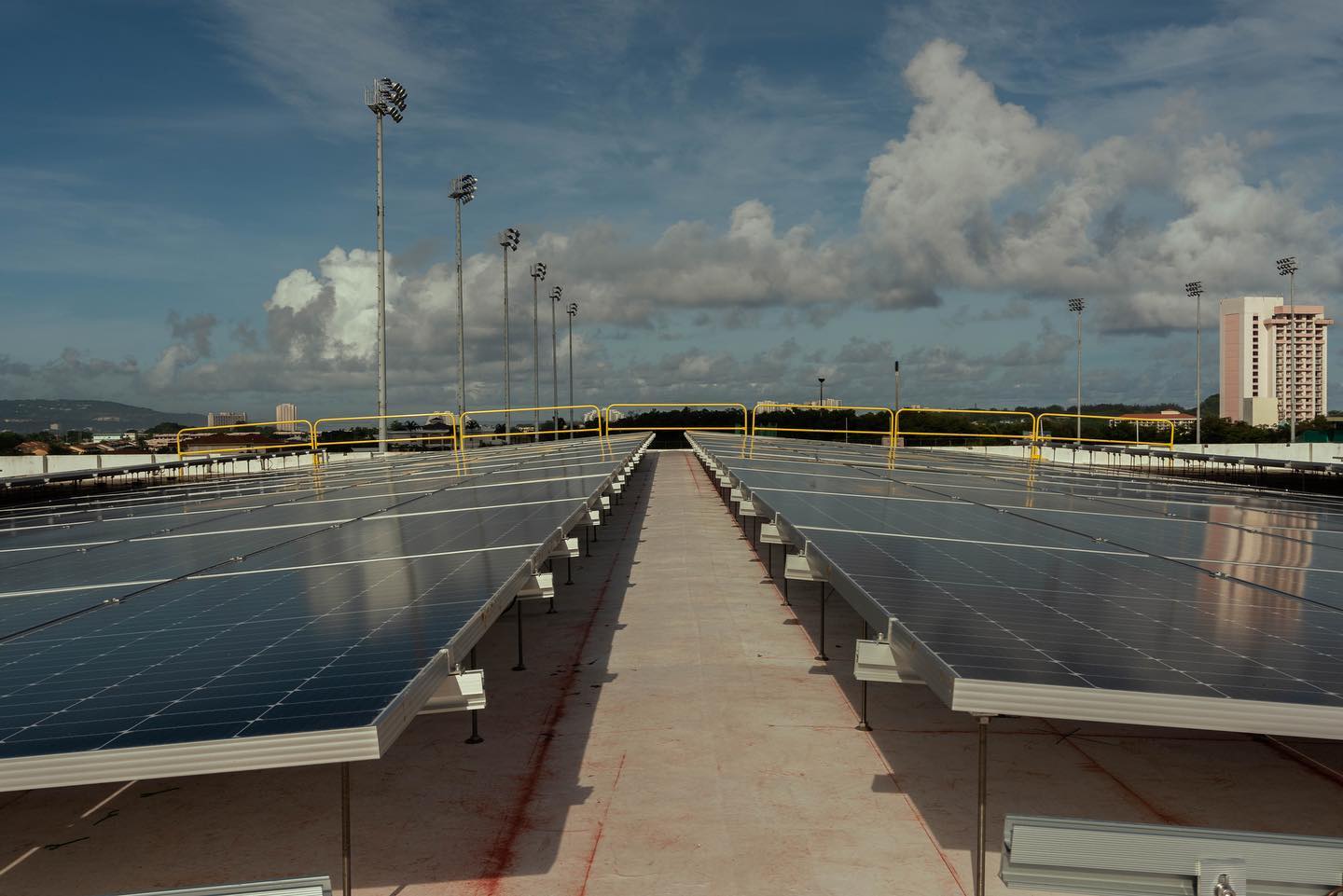
They installed 420 solar panels on the gym rooftop and upgraded the fluorescent lighting in some of the classrooms to efficient LED lighting with the JFK maintenance team.
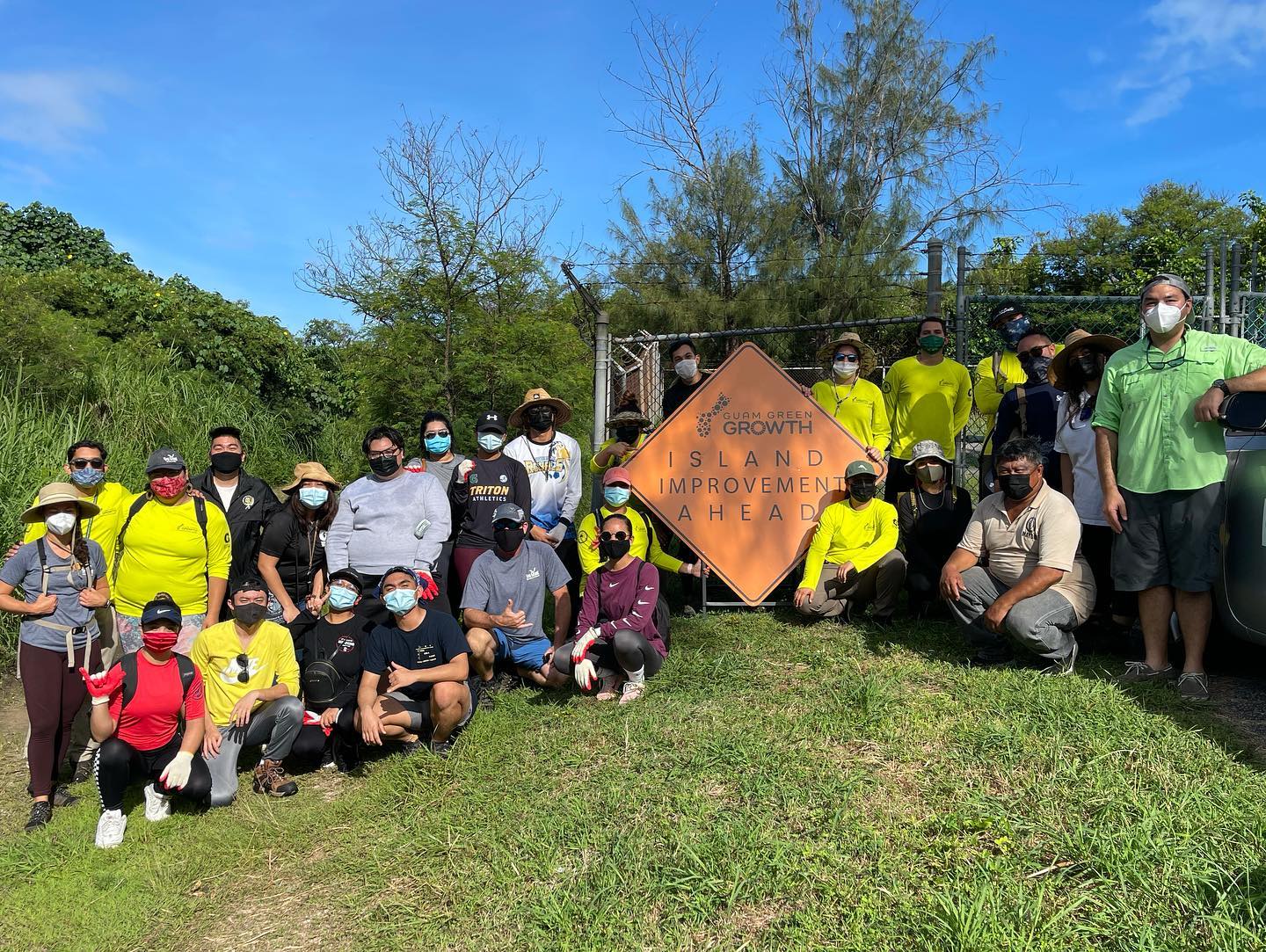
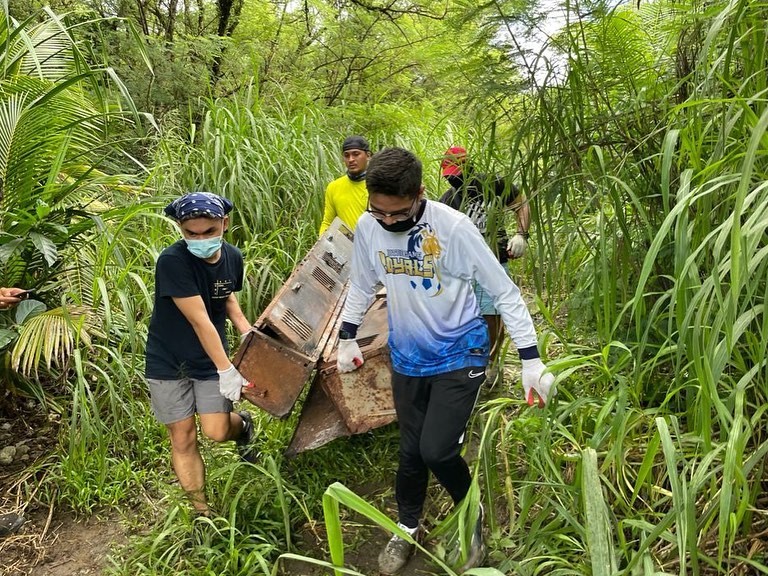
In Week 14, the Corps did an island beautification cleanup in Hagåt with the Mayor’s employees and then cleaned and bush cut areas in Humåtak alongside the Mayor’s team at the end of Week 15.
Conservation Corps assists with energy audit to help cut costs at GAIN animal shelter
Guam Green Growth Conservation Corps members Joseph Certeza and Alana Chargulauf inspect lighting fixtures while conducting an energy audit at the Guam Animals In Need facility in Yigo.
The University of Guam’s Guam Green Growth Conservation Corps participated in a hands-on energy survey of the Guam Animals in Need facility in Yigo under the guidance of Guam Power Authority staff.
After completing a basic orientation in September, the G3 Conservation Corps members conducted the energy assessment alongside GPA energy auditors at the Northern facility.
The energy survey involved an evaluation of the energy needs and efficiency of the facility, with the end goal of being able to recommend measures to improve energy efficiency, reduce energy consumption, and promote energy savings for the nonprofit organization.
Alison Hadley, GAIN executive director, emphasized the need for nonprofits to invest in sustainability, and one way to do that is to manage their overall energy consumption.
The UOG Green Growth Conservation Corps participated in a hands-on energy survey under the guidance of Guam Power Authority staff at the GAIN facility in Yigo.
“For the shelter, our form of sustainability is dealing with spaying and neutering of animals. But we still operate a facility and we still utilize utilities, so we have a responsibility to the community to demonstrate that type of responsibility as a nonprofit, especially since we are the ones that tend to struggle quite a bit financially,” she said.
As part of the energy survey, G3 Conservation Corps members participated in a walkthrough of the facility and conducted interviews with the GAIN team. The interview questions ranged from energy consumption patterns to the operations and functions of each room at the facility. Corps members also looked at interior and exterior lighting for wattage size and checked windows and doors for possible air leaks. The team also looked at the air conditioning units and located areas that may cause energy wastage.
According to Phil Cruz, sustainability coordinator at the UOG Center for Island Sustainability and Sea Grant, the survey data will be compiled into a report and forwarded to GPA for review. Then, the corps will send a final version of the report to GAIN, outlining the final list of recommendations.
“We also hope to reach out to GAIN a few months down the line and see if there are reductions to their power consumption based on the changes,” Cruz said.
Cruz stated that working with the nonprofit group was a win-win situation.
“We are so glad that we got the chance to learn about energy efficiency with GPA this week and had the chance to apply what we learned to help a group like GAIN that does so much for Guam. We are so glad to help them out in any way that we can,” he said.
Check out GPA’s website for more information on do-it-yourself and professional energy audits.
About the G3 Conservation Corps
The G3 Conservation Corps program prepares the community for the emerging green economy. The program is aligned with the island-wide efforts to achieve sustainability and other United Nations Sustainable Development Goals. It is a joint program of the UOG Center for Island Sustainability, the Office of the Governor, and Guam NSF EPSCoR’s Education & Workforce Development objective.
Taijeron’s G3 internship will have lasting impact on her future
While studying off island in Hawaii, Lauren Taijeron was ready to come home for the summer and put in some internship hours. Little did she know, that two months later, she would be returning to school to start her junior year with more insight, confidence, and a renewed spirit for her people.
Taijeron was a Guam Green Growth Summer intern and was assigned to the Commission on Decolonization (COD) in Adelup. The team worked closely with the Department of CHamoru Affairs (DCA) under Director Melvin Won Pat-Borja.
Taijeron is pursuing her bachelor’s degree in Pacific Island Studies and Political Science at the University of Hawaii (UH), where she says she learns about the Pacific and Oceania in a broader sense which grew her interest in learning more about Guam.
“Coming home and working with Melvin and DCA I learned a lot more about Guam’s history and it was really great,” said Lauren. “I felt like I didn’t really get that growing up, so getting to work with them directly, I got to learn everything I needed and wanted to learn about our island.”
During her internship with the COD Lauren spent some time working at the Guam Museum, and had the chance to assist on major projects including one that involved heads of state from all around the region.
“I learned ways to keep in contact with regional organizations and to continuously connect with them no matter the political status,” added Lauren. “Continuing those connections is very important.”
According to Taijeron, she did not find herself committed to any career path before she began her G3 summer internship, but found working with the COD left an immensely powerful impression on her.
“I want to work with decolonization,” explained Taijeron. “I’ve never seen a group that put that much work, that much heart, into their work.”
During her time with the group, she learned several things about important community subjects including healthcare, language preservation, and education, but said one of the biggest lessons she learned will influence her life moving forward.
“It has inspired me to believe in myself more,” explained Taijeron. “It just inspired me to not be afraid and know how capable I could be and it also taught me that I have so much to learn, and that’s okay.”
Taijeron will return to UH to finish her final semesters and plans to return to Guam and pursue work in support of decolonization following her graduation.
Guam Green Growth is a public-private partnership that develops tangible solutions to sustainability challenges and contributes to a green economy. For more information visit guamgreengrowth.org.
Climate action network expands island partnerships, affirms commitments
THE GATHERING: Climate Strong Islands Network Steering Committee member Jason Donofrio from The Ocean Foundation welcomed members to the meeting of the whole. The event was held virtually and produced out of Guam by the UOG Center for Island Sustainability.
The Climate Strong Islands Network (CSIN) is growing. As the University of Guam Center for Island Sustainability and other convenors reported during the 5th biannual gathering on Sept. 23, the network now has over 70 signatories representing a diverse coalition of partners and supporters all over the world.
In comparison, when Guam and other U.S. islands and entities signed the Climate Strong Islands Declaration in Puerto Rico on Feb. 26, 2020, the document had 60 signatories. The declaration sets forth principles, challenges, and opportunities faced by island communities in the U.S. In addition, it serves as a call to arms to help these communities respond to the climate change crisis effectively.
At the gathering, CSIN steering committee member Jason Donofrio of the Ocean Foundation, confirmed that the Climate Strong Islands network is expanding its reach, both in participation numbers and concrete action.
“We know it is important to continue to expand our geographical representation actively — to be as inclusive as possible,” he said. During the past year, Donofrio added that the steering committee had launched three sub-committees on policy, community outreach, and development to execute the action items of the network.
Donofrio also provided updates on CSIN’s policy and legislative advocacy. “The Climate Strong Islands Network has testified twice in Congress related to the ocean-based climate solutions bill and submitted a formal recommendation on ways to improve the legislation to be more effective for islands,” he said.
Director of UOG CIS and Sea Grant Austin Shelton also serves as the CSIN Steering Committee Co-Chair
UOG Center for Island Sustainability director and CSIN steering committee co-chair Austin Shelton also reported on the increase in island representation. At the local front, he said the network will help Guam advance local climate action in alignment with the Guam Green Growth Initiative (G3) and Climate Change Resiliency Commission.
“I am pleased to report that we have been growing stronger since the last time we gathered. In addition to our network cohost, the Ocean Foundation and Global Island Partnership, we now have an incredible network coordinator, and a policy team moves our collective efforts forward. We’ve grown our steering committee to be more representative of more island voices,” Shelton said.
More than 100 participants participated in 6 breakout groups at the gathering representing the following key action items: disaster preparedness, food security, watershed planning, renewable energies, economic resilience, and sustainable marine economy.
The gathering also featured two bright spot presentations highlighting successful efforts by partners in implementing climate change solutions. First, Lirio Marquez of the Vieques Conservation Conservation and Historica Trust of Vieques, Puerto Rico, presented the successes of the Proyecto Mangle. The volunteer-based mangrove restoration project in the Puerto Mosquito Bioluminescent Bay highlighted the need to mobilize the community for ecological conservation.
The Gathering featured Brightspot Presentations from partners and featured speakers from throughout the world including Puerto Rico and St. Paul Island.
Next, Lauren Divine and Marissa Merculieff presented on the Aleut Community of St. Paul Island. They described the PRibilof islands marine ecosystem (PRIME) management strategy. PRIME is a community and ecosystem-based system rooted in the recovery of keystone species, maintenance of indigenous cultural traditions, and implementation of indigenous-led research and management.
The 5th CSIN biannual gathering aims to get input from stakeholders to support CSIN’s national policy framework and drum up interest and participation in the network. UOG CIS and the G3 team facilitated the biannual gathering.
Governor Lou Leon Guerrero, one of the original signatories of the CSIN declaration, lauded the network for its efforts, “It is encouraging that this essential work of islands continues to connect vast oceans to tackle climate change — the biggest challenge of our lifetime and our very existence. Although we are islands far away from each other, the oceans connect us, and together, we are strong, and we are resilient,” she said.
RESOURCE: NEW NATIONAL NETWORK HIGHLIGHTS CHALLENGES AND OPPORTUNITIES FACED BY U.S. ISLANDS IN BUILDING CLIMATE RESILIENCE
SUZANNE MACDONALD
POSTED 2021-09-20
www.islandinstitute.org
“Under the weight of climate change impacts—biodiversity loss, debilitating storms, and swallowing seas—islands are not sinking. Strong and resilient, islands are rising.”
In solidarity, islands are uniting in common purpose….islands are distant, but they are not alone. Together, Islands Are Rising.”
DR. AUSTIN J. SHELTON Director of the University of Guam Center for Island Sustainability and Sea Grant and Co-Chair of the Climate Strong Islands Network Steering Committee
These excerpts from Dr. Austin Shelton, director of the University of Guam Center for Island Sustainability and Sea Grant, in his March 2021 testimony to Congress help get to the heart of why the Island Institute is helping to launch a new, national network focused on increasing the climate resilience of islands across the U.S. The Climate Strong Islands Network is building momentum for local and federal action on climate for islands that are U.S. territories, states, and parts of states, and Shelton serves as a co-chair. As we help to prepare for the network’s September 23rd virtual fall gathering, I want to share why the Island Institute is leaning into this important work.
Throughout our nearly 40-year history, the Island Institute has often played a role to help connect Maine’s island communities to other, similarly situated communities in the U.S. and beyond. By participating in networks, learning exchanges, and even research publications, we’ve seen the value in helping Mainers expand their networks and even build their confidence as leaders by providing an avenue for them to share the stories of their hard work. Over the past five years, this approach has become an intentional part of our program design: creating opportunities that make it easier for local leaders to access what has worked in other places and partnering beyond Maine to create opportunity for our coast and others.
UOG G3 Conservation Corps members dig up a portion of land near the Togcha cemetery to remove chain of love tubers from the soil.
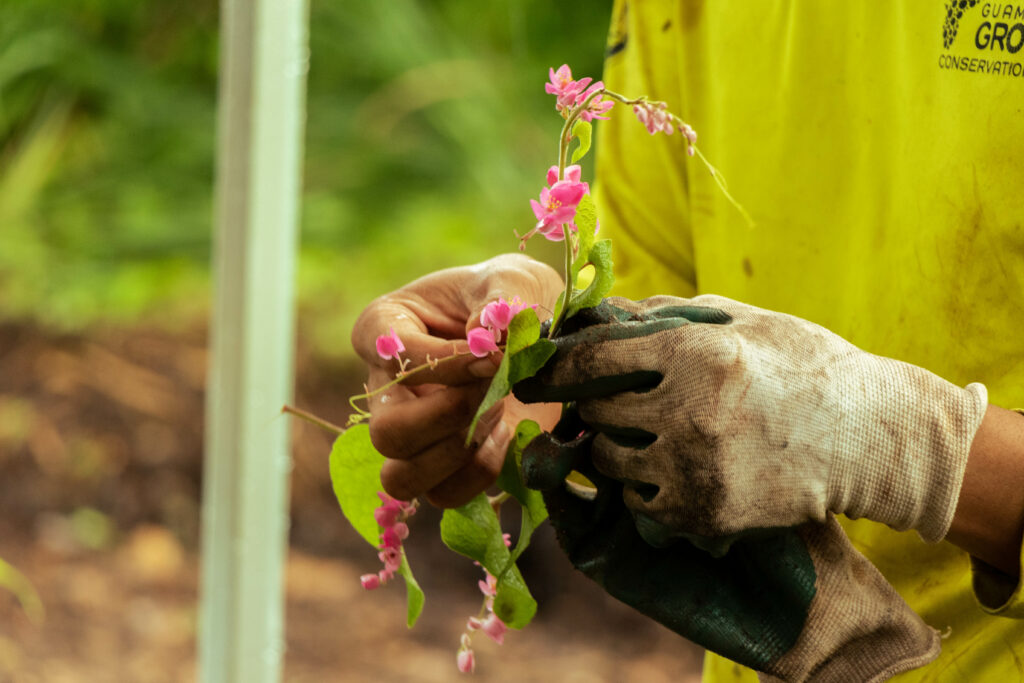
A member of the UOG G3 Conservation Corps holds a chain of love tendril with pink flowers. The vine was introduced as an ornamental and was first recorded on Guam as early as 1905 by botanist William Safford.
As part of their training with the University of Guam’s Guam Green Growth initiative, the G3 Conservation Corps members recently participated in an activity from Sept 7 to 10 to clear portions of land overrun by an invasive vine —- the chain of love (kadena de amor) — and repurposed parts of the plant into viable products for the circular economy.
In partnership with the Guam Department of Agriculture, the corps members harvested the vine from a patch of Yona land near the entrance of the Togcha cemetery, an area with a heavy overgrowth of the invasive creeper. The vine reproduces by tubers and creates a canopy cover that prevents underlying plants and trees from receiving sunlight and photosynthesizing food. According to a publication from the UOG College of Natural and Applied Sciences, the vine was introduced as an ornamental and was first recorded on Guam as early as 1905 by botanist William Safford.
At the site, Christine Camacho Fejeran, Forestry Division Chief, Forestry and Soil Resources Division at the department provided an orientation on the removal of the invasive plant species. She said the G3 Conservation Corps chose one of the most challenging conservation and clean-up sites on island. “We at the department appreciate the efforts of the G3 Conservation Corps,” Fejeran said, adding that the removal process could guide landowners on how to harvest the invasive vine from their properties.
Alana Chargualaf, G3 Conservation Corps member, said that they must ensure the chain of love tubers and root system are removed completely from the ground to prevent the plant from repropagating. “If it stays in the dirt, it will grow again. It is the type of plant that can survive droughts,” she said.
Gov. Lou Leon Guerrero and Lt. Gov. Joshua Tenorio also visited the site on Wednesday to commend the efforts of the group.
The G3 Conservation Corps members were also tasked to find other uses for the invasive vine, following the circular economy framework. The circular economy system promotes the regeneration of natural systems, reuse or recycling of materials to extend their life cycle and divert waste from the landfill.
Jackie Jones, another G3 Conservation Corps member, said, “We are still in the experimental stage and trying to figure out what can we do with this — to take something that has been such a problem and turn it into a part of a solution.”
The G3 Conservation Corps program prepares the community for the emerging green economy. The program is aligned with the current island-wide efforts to achieve sustainability and other UN SDGs. It is a joint program of the UOG Center for Island Sustainability, the Office of the Governor, and Guam NSF EPSCoR’s Education and Workforce Development objective.
UOG President Thomas Krise and Senior Vice Provost Anita Borja-Enriquez pose with cutting boards that were engraved using a laser cutter from the G3 Circular Economy Makerspace and Innovation Hub located in the Chamoru Village.
The G3 Circular Economy Makerspace and Innovation Hub includes a variety of tools and equipment that will be used to turn waste products into marketable products.
Cathleen Moore-Linn, the executive director of the Research Corporation of the University of Guam, holds a pen stand that was created using the laser cutter at the G3 Circular Economy Makerspace and Innovation Hub.
The Guam Green Growth (G3) Initiative is preparing for its G3 Circular Economy Makerspace and Innovation Hub opening at the CHamoru Village in Hagatña.
The circular economy is a model of production and consumption which involves sharing, leasing, reusing, repairing, refurbishing and recycling existing materials and products as long as possible. In this way, the life cycle of products is extended.
The G3 Circular Economy Makerspace and Innovation Hub will enable entrepreneurs to gather in a facility filled with tools and equipment that will be used to turn waste products into marketable products.
“On Guam, we import a lot of the things we consume,” said UOG President Thomas Krise. “Using this makerspace, we can recycle things like plastic, wood products, and problematic species such as bamboo. I think there’s a lot of potential for creativity that’s also helpful in terms of sustainability and developing the economy.”
The facility occupies three houses in the CHamoru Village. The industrial makerspace holds most of the larger equipment such as a laser cutter, a computer numerical control router, and multiple 3D printers. It also houses a collection of power tools which members can use.
“In a time of struggling businesses, UOG and our partners will work through this G3 makerspace to stimulate new industries and put ownership of the emerging green economy into the hands of our people,” said Austin Shelton, director of the UOG Center for Island Sustainability.
The second makerspace house will feature equipment from Precious Plastic, a plastic recycling project that uses machines to grind, melt, and mold discarded plastic into new products. By next year, the makerspace will install the latest series of equipment from
Precious Plastic and will also include a palm leaf plate presses as an alternative to polystyrene foam plates and bowls.
Once products are created in the makerspace, they can be incubated and incubated and sold at the G3Green Store. The store is a shared space with the innovation hub, which will provide business-related workshops and trainings for the makerspace’s equipment. “The team here showed me the possibilities for our island’s future and it’s looking very exciting for the next twenty years,” said Angelo Diether Paule, the president of the UOG Student Government Association.
The exact date of the public opening of the makerspace is being determined. When the G3 Circular Economy Makerspace and Innovation Hub is fully operational, members of the community can make appointments to use the facility’s equipment and resources.
“I think the value this facility gives in terms of reverse engineering to us is great,” said Robert Jackson, the deputy project director and chief operations officer of DZSP21. “A lot of our equipment is older and we do run into supply chain issues when it comes to obsolete parts. Being able to leverage this technology to solve those challenges is exciting. I look forward to exploring those possibilities.”
The G3 Circular Economy Makerspace and Innovation Hub was made possible by funding from Guam NSF EPSCoR, the Guam Economic Development Authority, Office of the Governor of Guam, and partnerships with the UOG Center for Island Sustainability, UOG Sea Grant, the School of Business and Public Administration, and Guam Unique Merchandise and Arts.
For inquiries about touring the G3 Circular Economy Makerspace and Innovation Hub, please contact G3 Circular Economy Coordinator Myracle Mugol from Guam NSF EPSCoR (mugolm@triton.uog.edu).
G3 Community Garden to provide education and inspiration for healthy and sustainable living
A newly developed communitygarden across from the Guam Museum in Hagåtña will be a place where residents can learn, volunteer, and gain inspiration for sustainable living.
The garden is a project of the island-wide Guam Green Growth (G3) initiative, a public-private partnership facilitated by the Center for Island Sustainability at the University of Guam and supported by the Office of the Governor that creates solutions to sustainability challenges and fosters the island’s alignment with the United Nations’ 17 Sustainability Development Goals (SDGs).
The communitygarden addresses SDG #2: Zero Hunger, SDG #3: Good Health and Wellbeing, and SDG #11: Sustainable Cities and Communities.
“A lot of the conversations during the pandemic revolved around food security and the vulnerability in having to import over 90 percent of all the foods and goods we consume,” said Austin Shelton, co-chair of the Guam Green Growth Steering Committee and director of the UOG Center for Island Sustainability. “This is not just going to be a place to grow food, but it also will be a beacon of hope and a demonstration to all the other villages that they can do something similar.”
The 1,400-square-foot garden was designed by nonprofit group Guåhan Sustainable Culture (GSC), and the raised garden beds were built by the G3 Conservation Corps, AmeriCorps GSC members, and Pacific Federal Management Inc.
GSC will manage and continue to develop the garden with its AmeriCorps GSC team and will host garden volunteer days, where community organizations and groups will be invited to volunteer, and educational opportunities focused on food security and healthier lifestyles. GSC co-founder Michelle Crisostomo said that trellises will be installed for vining plants and that a section of the garden will be developed to educate children about agriculture and nutrition.
Attendees of a ground-raising ceremony on Aug. 19 planted peppers, eggplant, basil, and passionfruit seedlings. A portion of what is harvested will be given to the homeless and impoverished individuals and families.
“This communitygarden is a great demonstration of partnership,” said UOG President Thomas Krise. “The partnerships for achieving the Sustainable Development Goals are really central to the success of all of this.”
Other partners and supporters in the project include the 36th Guam Legislature, Guam Waterworks Authority, and the Serve Guam Commission.
“This communitygarden is a testament to the progress that Guam Green Growth has made to advance the U.N. Sustainable Development Goals,” said Gov. Lou Leon Guerrero. “We hope that this garden will provide nutritious food to the people of our island.”