G3 Conservation Corps helps plant more than 2,000 trees to prevent erosion

G3 Conservation Corps helps plant more than 2,000 trees to prevent erosion

The growing reforestation movement was in full display as more than 2,000 trees were planted in the hills of Malesso’ on July 24 by the Guam Green Growth Conservation Corps of the University of Guam Center for Island Sustainability alongside the Department of Agriculture Forestry Division, and more than 200 interns and volunteers.

The effort was part of the As Gadao Manell Watershed Restoration Project and one of several Island Beautification Task Force activities organized by the Office of the Lieutenant Governor of Guam to commemorate Guam’s 77th Liberation Day. 

“[The Forestry Division] is trying to plant trees to prevent erosion, to put back and recover native and endemic species, and try and solve some environmental issues out there,” Lt. Gov. Joshua Tenorio said. “Tree planting this morning is one of the very critical pieces in the plan.”

The G3 Conservation Corps members spent the week prior working alongside the DOA team preparing the land for the planting event.

“We spent about four days bush-cutting in a very specific manner, taught by the forestry team, to prepare the land for this event, and it made it so easy for the volunteers to come in and plant so many trees,” said G3 Conservation Corps member Joey Certeza.  “Preparing the land, and now seeing it with so many people helping out, is very satisfying and gratifying.” 

The corps members created contour lines in the southern ridge to create space for trees to be planted and pruned previously planted acacia trees (Acacia auriculiformis) to prepare for the introduction of understory natives to develop a native forest.

“We are working to convert the highly fire-prone landscape, which is dominated by invasive grass species, to forested lands,” said Christine Fejeran, the Forestry and Soil Resources Division chief at the Guam Department of Agriculture. “The acacias help amend soils and shade out the grasses giving native trees a chance, once planted.”

The G3 Conservation Corps is a newly launched workforce development program preparing the local community for the emerging green economy. It is part of the Guam Green Growth initiative, the island’s most comprehensive public-private partnership ever created to achieve a sustainable future for the island. 

The Guam Green Growth Conservation Corps is a joint program of the University of Guam Center for Island Sustainability, the Office of the Governor, and Guam NSF EPSCoR’s Education and Workforce Development objective. T

UOG receives national award for sustainability leadership of Guam Green Growth

UOG receives national award for sustainability leadership of Guam Green Growth

The University of Guam is one of 11 universities to win a 2021 Excellence and Innovation Award from the American Association of State Colleges and Universities. The UOG Center for Island Sustainability received the Sustainability and Sustainable Development Award for facilitating climate and sustainability solutions in the community through the island-wide Guam Green Growth (G3) Initiative.

“To receive one of 11 awards among the association’s membership of 400 public colleges and universities is quite telling that we — as a university and as an island — are not only effectively leading our community in sustainability solutions, but we’re setting an example nationwide,” said UOG President Thomas W. Krise.

AASCU President and CEO Mildred García said the UOG Center for Island Sustainability was selected by the awards committee “for its outstanding results and potential to influence and serve as a model for other institutions.” 

Guam Green Growth is an island-wide initiative to locally implement the 17 United Nations Sustainable Development Goals. It is the most comprehensive public-private partnership ever created achieve a sustainable future for Guam. 

The Center for Island Sustainability has facilitated the initiative, which brought together 99 individuals from all sectors of society appointed through Gov. Lou Leon Guerrero’s Executive Order 2019-23. The working group members developed an “Action Framework” that was formally adopted by the governor in September 2020 and now guides implementation of the 17 U.N. Sustainable Development Goals in locally and culturally effective ways.

“Guam Green Growth is a remarkable partnership between all sectors of our society to create a sustainable future for our island,” the governor said. “Congratulations to the University of Guam for this distinct and well-deserved honor as the facilitators of this island-wide movement.”

Austin Shelton, director of the Center for Island Sustainability and co-chair of the G3 Steering Committee, said this is an award for the working group members from the community as well, who took a personal interest in the island’s future and dedicated their time and expertise to creating this plan. 

“Thanks to all the dedicated G3 Working Group members and supporters,” Shelton said. “Guam is demonstrating that we are a global leader in island sustainability. Through G3, we are taking local action to ensure a sustainable global future.”

The university will be officially recognized among the other awardees during the 2021 AASCU Annual Meeting on Nov. 7 in Florida.

G3 Commitment

Mayors holding G3 Commitment badges they were awarded
Guam Green Growth Commitment Logo

The Guam Green Growth Commitment program invites the community to participate in creating a sustainable future for our island. Businesses, non-profits, educational institutions, and community groups can earn badges linked to the United Nations Sustainable Development Goals (SDGs) in recognition of their actions to advance sustainability.

THE BADGES

The badges are linked to the United Nations Sustainable Development Goals (SDGs). Therefore, there are 17 badges that businesses, organizations, educational institutions, and community groups can apply for and attain.

HOW TO ACHIEVE A BADGE

To attain a Guam Green Growth Commitment badge, your organization must uphold the principles of demonstrating local leadership to advance the UN SDG(s) through long-term commitment to sustainable development, climate justice, and resilience. There are three ways to attain a G3 Commitment badge. Businesses, organizations, educational institutions, and community groups can do any of the following:

STEPS TO APPLY

To apply for a badge, you must be a business, non-profit organization, community group, educational institution, and/or mayors office. To be eligible for a badge, your organization must be carrying out sustainable efforts that coincide with the targets of the badge your organization is applying for. It’s as simple as that!

BADGE ROLLOUT SCHEDULE

Beginning in April 2021, every six months will be a rollout of a new set of badges. The second rollout in each year will be in October. 

APPLY FOR A G3 COMMITMENT BADGE TODAY!

VIDEO: Governor Lou Leon Guerrero addresses the GLIPSA Community Coordination Call

Add Your Heading Text Here

Governor Lou Leon Guerrero, a new Global Island Partnership Leader, had an inspiring message for attendees of the Global Island Partnership (GLISPA) Community Coordination call today.
 
Guam is a member of GLISPA whose mission is to promote action to build resilient and sustainable island communities by inspiring leadership, catalyzing commitments and facilitating collaboration for all islands.
 

12 village mayors recognized for advancing UN SDGs

12 village mayors recognized for advancing UN SDGs

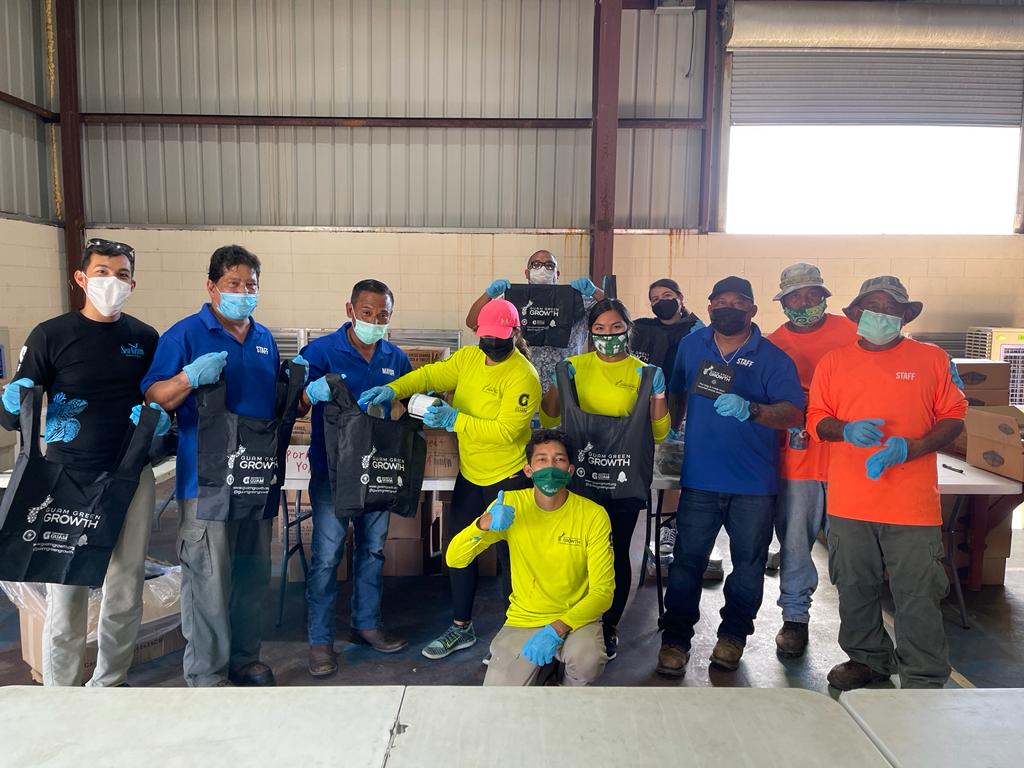
At the Mayors Council of Guam meeting Wednesday, July 7, the Guam Green Growth (G3) team awarded plaques to twelve village mayors for their efforts in advancing the first and second Sustainable Development Goals of “No Poverty” and “Zero Hunger.”  

The mayors were recognized for their participation in the Guam Green Growth Commitment (G3C) badge program. The G3C program recognizes and rewards participation from businesses, organizations, educational institutions, and community groups in developing and creating sustainable practices that align with the Guam Green Growth Action Framework and the 17 UN Sustainable Development Goals.  

At the MCOG meeting, Dr. Austin Shelton, UOG Center for Island Sustainability director, said, “We would like to recognize the first few mayors who committed to the Guam Green Growth Initiative and these Sustainable Development Goals. We are offering badges to earn in the Sustainable Development Goals — no poverty and zero hunger —- and we are thankful to the mayors who have stepped up and shared the initiatives that you are doing.” 

Annania Nauta, G3 project coordinator, awarded the plaques to the mayors of Agat, Barrigada, Dededo, Hagåtña, Humåtak, Inalåhan, Mangilao, Mongmong-Toto-Maite, Piti, Sinajana, Tamuning-Tumon-Harmon, and Yona for the sustainable efforts at their respective villages.  

Actions that could make an organization or mayor’s office achieve a badge include assisting with food commodity distribution or supporting backyard farming. The badge program will be rolled out over five years, starting with badges for poverty and hunger and gradually advancing through all 17 SDGs.  

“The G3 Badge Program is important because achieving goals to end poverty and hunger will hopefully produce healthy and sustainable communities,” said MCOG President and Mayor of Piti Jesse Alig.  “The mayors and vice mayors continue to work collaboratively with the Conservation Corps to educate and execute projects that support the Sustainable Development Goals.” 

At the MCOG meeting, three members of the G3 Conservation Corps also spoke about strengthening partnership and collaboration with the different villages through the G3 Conservation Corps initiative. 

 Alana Chargualaf, G3 Conservation Corps member, said the UN SDGs offer a holistic approach to bringing the island to where it needs to be. “Not just environmentally, but through education. How we interact with each other — and the inafa’maolek and harmony that we always talked about and we try to promote. We can carry those out through our 17 Sustainable Development Goals,” she added. 

Meanwhile, Joey Certeza, another G3 Conservation Corps member, said the village-based cleanup and beautification activities with the mayors is just a start. “(In Yigo) We collected 33 trash bags in just one portion of the village but we are just a group of 12. Imagine if we collaborate better to do a village effort, to do an islandwide effort,” Certeza said. 

The G3 Conservation Corps (G3CC) program prepares the community for the emerging green economy. The program is aligned with the current island-wide efforts to achieve sustainability and other UN SDGs.

Guam Green Growth invites volunteers to weekly roadside cleanups

Guam Green Growth invites volunteers to weekly roadside cleanups 

The Guam Green Growth (G3) Conservation Corps continued its weekly island beautification schedule today with a roadside cleanup along Marine Corps Drive in Dededo. The community is invited every Friday to join the group’s cleanup effort, which will be in Barrigada next Friday and in a different village every week throughout the five-month program. 


The G3 Conservation Corps is a five-month workforce development program launched last month under the Guam Green Growth initiative, which is being facilitated by the University of Guam Center for Island Sustainability in cooperation with the Office of the Governor.  


The cleanups, in a partnership with the Guam Mayors’ Council and the Island Beautification Task Force, involve picking up trash and appliances from the roadside and jungle and separating recyclable litter. 


“This cleanup is to beautify our island,” said G3 Conservation Corps member Kevin Wong. “A lot of these items are not biodegradable. If we do not dispose of them properly, they are going to end up completely trashing the side of the road.” 


Since the start of the program, the G3 Conservation Corps has collected more than 40 trash bags of waste along Marine Corps Drive in Mangilao, Tamuning, and Yigo.  


The cleanups are open to community volunteers every Friday. Interested volunteers can pre-register and see the updated schedule online at www.guamgreengrowth.org 

Cleanup Schedule for July:  

  • July 16: Barrigada  
  • July 23: Mongmong-Toto-Maite  
  • July 30: Mangilao  


The G3 Conservation Corps program is made possible through the Recycling Revolving Fund following approval from the Guam Environmental Protection Agency Board of Directors. 


What is G3? 

Aligned with the 17 U.N. Sustainable Development Goals, the Guam Green Growth initiative, or G3, is an island-wide initiative to cultivate an ecosystem for transformative action to achieve a sustainable, prosperous, and equitable future for the island. G3 is facilitated by the University of Guam in cooperation with the Office of the Governor of Guam and the 99 members of the G3 Working Group representing all sectors of our society.  

UOG CIS joins global islands partnership addressing climate change

UOG CIS joins global islands partnership addressing climate change

U.S. Special Presidential Envoy for Climate John Kerry says the US government supports the Local2030 Islands Network. 

The University of Guam Center for Island Sustainability (UOG CIS) is proud to support an initiative that links Guam and other small island communities and nations in a partnership focused on advancing climate action and other UN Sustainable Development Goals.  

Guam, Hawaii, and Puerto Rico are part of the Local2030 Islands Network — the world’s first global, island-led initiative of its kind. Other island members and partners include the Republic of the Marshall Islands, Federated States of Micronesia, Bonaire, Ireland, and the UN Foundation. 

As part of the network, member-nations and communities commit to promote locally driven models and concrete actions toward achieving the 17 UN SDGs. Goal 13of the UN SDGs calls for urgent action to combat climate change and its impacts.  

U.S. Special Presidential Envoy for Climate John Kerry made the announcement of support in April, during an event hosted by President Joe Biden in support of the Leaders’ Summit on Climate Change. 

“The (U.S.) Department of State, NOAA (National Oceanic and Atmospheric Administration), and Department of Energy, are supporting the Local2030 Islands Network, an innovative and peer-to-peer network that connects U.S. islands with our fellow islands around the world on local solutions and common challenges,” Kerry said.  

On Guam, UOG CIS has been at the forefront of efforts to broaden partnerships across sectors for the Local2030 Islands Network initiative. 

Austin Shelton, UOG CIS director, said the statement of support from the US government is a boost to efforts to address climate change and other sustainability goals, “Guam and other islands are at the frontlines of this effort. The statement from the U.S. Special Presidential Envoy for Climate John Kerry signifies that the national government recognizes local and regional action to address climate change.” 

The Local2030 Islands Network is managed by Hawaii Green Growth Local2030 Hub and the Global Island Partnership. At the event, Hawaii Governor David Ige discussed the leadership of islands globally on energy and climate, and highlighted the Aloha+ Challenge, Hawaii’s SDG framework grounded in local values. In his remarks, Ige also encouraged island leaders and island jurisdictions to become involved in the network.  

“American islands are stepping up together, with islands like Guam and Puerto Rico joining the Network in addition to the Marshall Islands and other island economies,” Hawaii Governor David Ige. 

For her part, Guam Governor Lou Leon Guerrero supported the Hawaii Governor’s call for broadening participation in the network. Leon Guerrero said, “As a founding member of the Local2030 Islands Network and an adopter of the concept of green growth, I implore other island leaders to join this undertaking to accelerate our progress for a more sustainable, equitable, and prosperous future.” 

fact sheet  from the White House described U.S. government’s commitment to work with small islands in their efforts to combat the climate crisis in ways that reflect their unique cultures and development challenges by building resilience in the face of a changing climate.  

 The White House also said that the State Department, NOAA, DOE, and the U.S. Agency for International Development (USAID) will launch a new partnership to advance the inclusion of locally generated climate information, knowledge, data and decision support tools in ongoing and emerging sustainability and resilience endeavors in island regions. 

Guam Green Growth launches G3 Conservation Corps

Guam Green Growth launches G3 Conservation Corps

What do a retired corrections officer, a former journalist, a teacher, and an indigenous artist have in common? They are all part of the first cohort of G3 Conservation Corps members of the Guam Green Growth (G3) initiative.  


The University of Guam announced the 12 members of the G3 Conservation Corps at a program orientation last Wednesday at UOG. Following the orientation, the group participated in its first village cleanup in Mangilao. 


Last month, the university embarked on an island-wide recruitment process for the program. The program received hundreds of applicants, and 12 were selected through a comprehensive review process for the five-month program.  


From June to November, the G3 Conservation Corps members will participate in workforce development training and activities focused on island beautification, circular economy and recycling, invasive species removal, energy efficiency, and agriculture and aquaculture. 


At the orientation, UOG Center for Island Sustainability Director Austin Shelton said the program is aligned with the current island-wide efforts to achieve sustainability and other United Nations Sustainable Development Goals. 


“This is one of our implementation projects for the overall Guam Green Growth initiative, which was established in 2019 in partnership with the Office of the Governor and the University of Guam to implement — in locally and culturally effective ways — the 17 U.N. Sustainable Development Goals. This G3 Conservation Corps program is meant to prepare our community for the emerging green economy. Sustainability is an important component that we want to make sure is part of the conversation and the action for the economic diversification of our island,” Shelton said. 


Lusech Ngirakesau, a recent UOG business administration graduate and G3 Conservation Corps member, said the program would benefit Small-Island Developing States, or SIDS. Coming from Palau, a small island nation, he said he sees the importance of the program for participants to acquire skills and develop a sustainability mindset.  


Meanwhile, Madeline Bradley, the youngest G3 Conservation Corps member at age 18, said the program is an amazing start to promote sustainable action.  


“For the next nine years, we have to conserve our world, basically,” she said, speaking of the 2030 target date for the U.N. Sustainable Development Goals. “But it is a great start for Guam to realize that we need to start doing things for Guam a lot faster. And we need to do things for Guam more efficiently. I feel that this is going to be a wakeup call for a lot of villages and a lot of village mayors — just people in general.” 


UOG President Thomas W. Krise, in the past, had described the program as an engine of innovation developing tangible solutions to sustainability challenges in our island region. He said growing the island’s skilled workforce is a solution to support the diversification of the island economy. 


At Wednesday’s launch, Krise emphasized the program’s importance as Guam transitions out of the pandemic and recovers its economy.  


“This is a great time to be pressing the kinds of things that the G3 initiative is pressing across the board in terms of economic activity, sustainability, education. It is really important to build that capacity in people to think about sustainability, the circular economy, and the Sustainable Development Goals,” he said.  


The G3 Conservation Corps program is made possible through the Recycling Revolving Fund following approval from the Guam Environmental Protection Agency Board of Directors. 


About G3


Aligned with the 17 U.N. Sustainable Development Goals, the Guam Green Growth Initiative, or G3, cultivates an ecosystem for transformative action to achieve a sustainable, prosperous, and equitable future for Guam. The University of Guam facilitates the island-wide initiative in cooperation with the Office of the Governor of Guam and the 99 members of the G3 Working Groups, representing all sectors of society.  


###

Skip to content