Graduates of UOG’s G3 Kupu Conservation Corps challenged to make a difference

Uncategorized

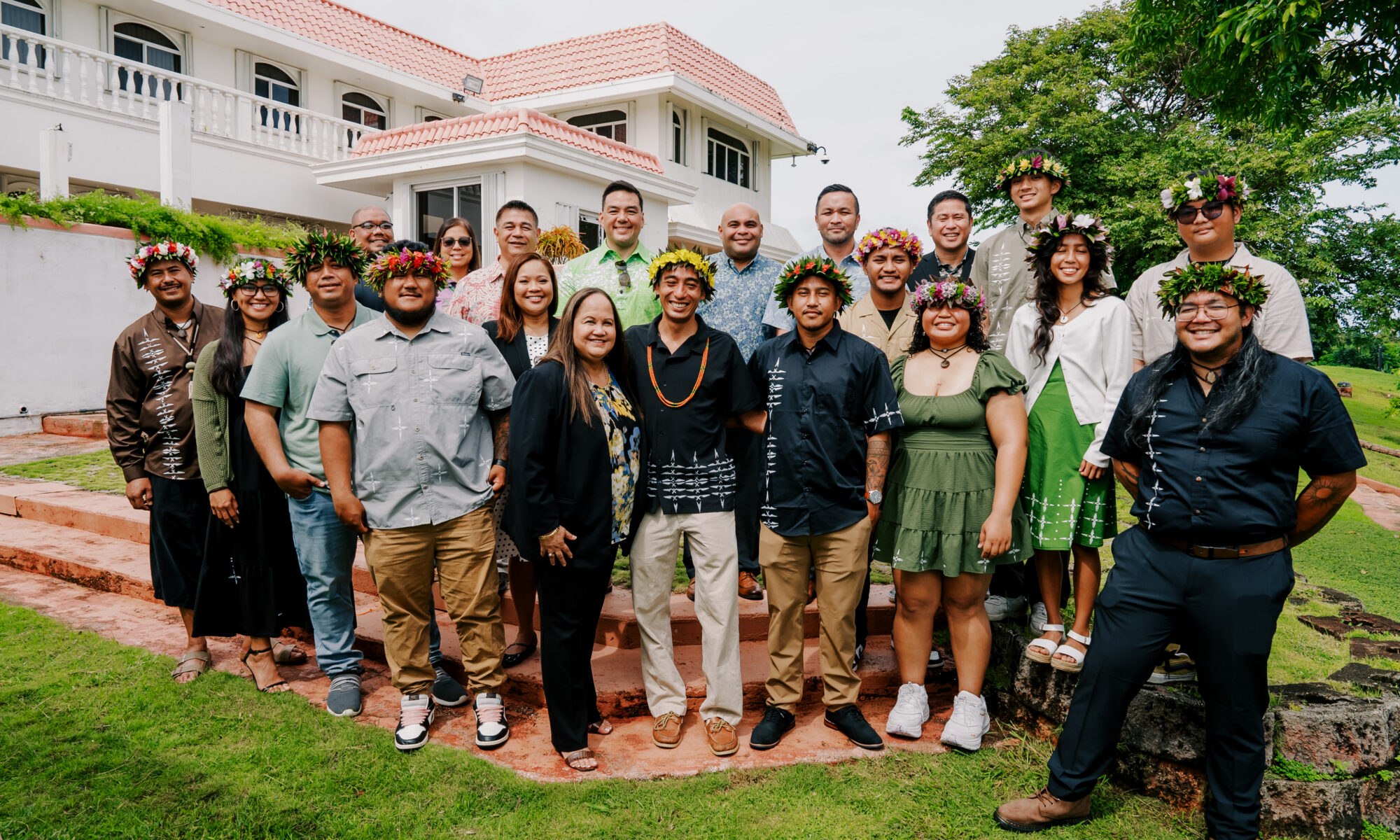
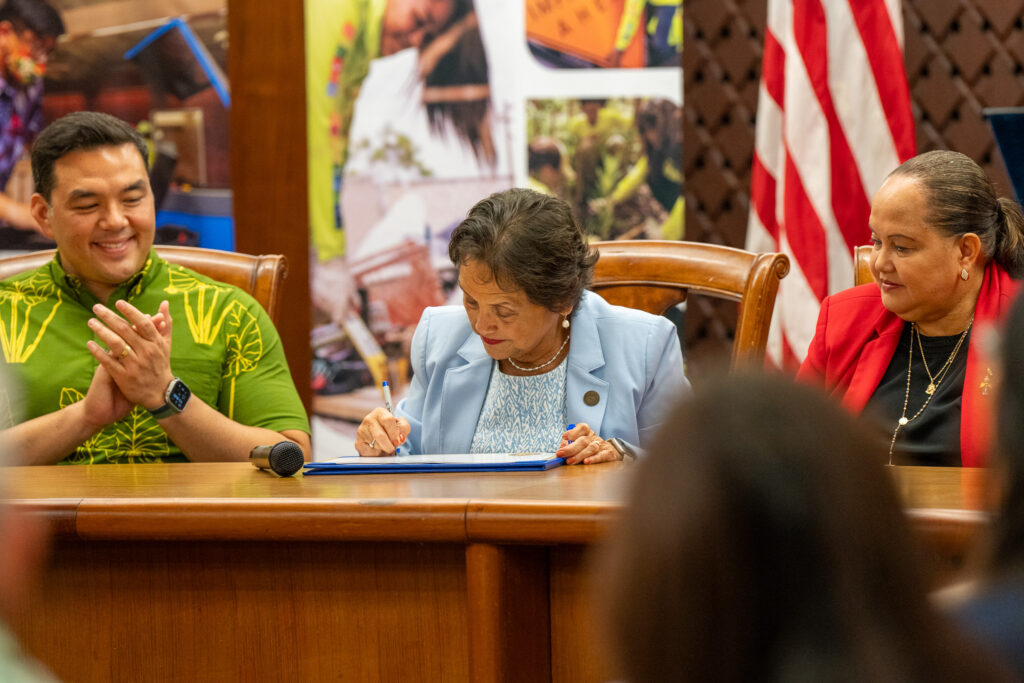
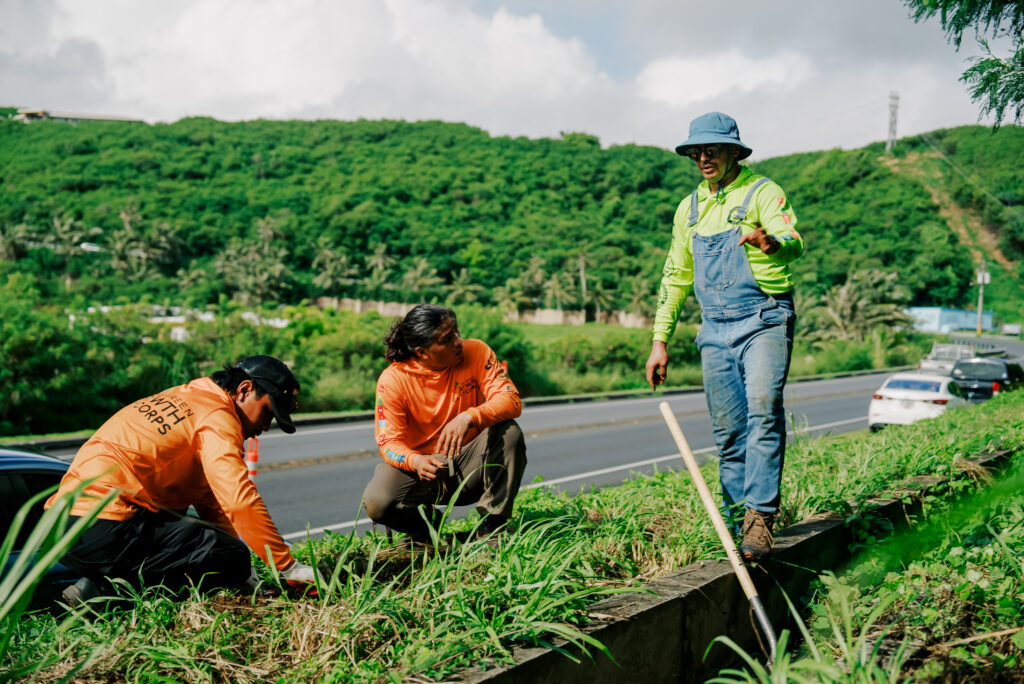
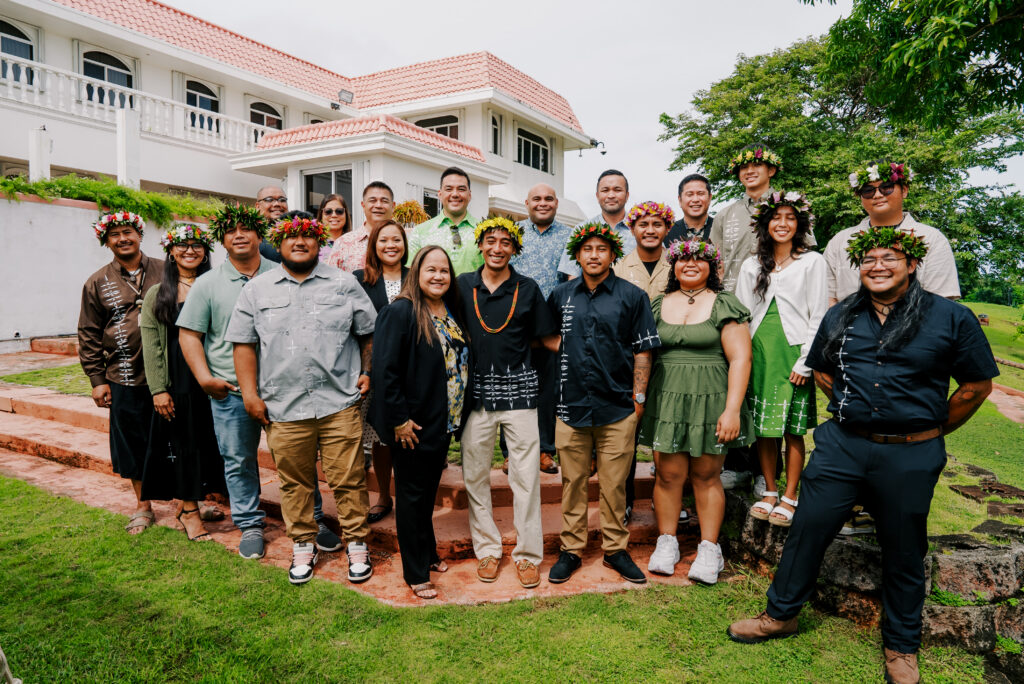
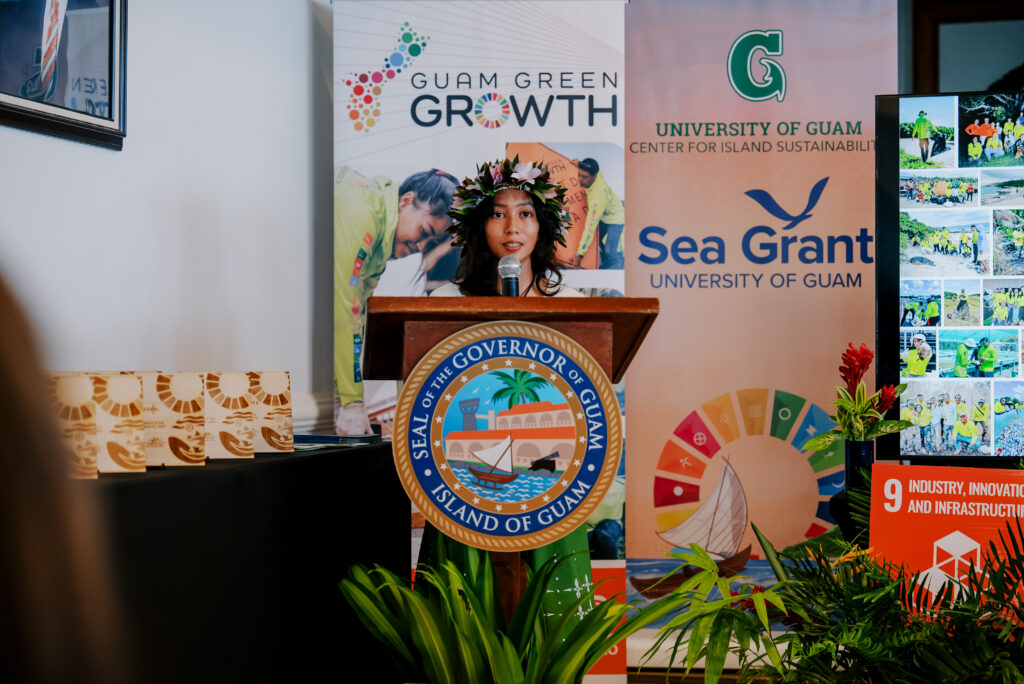
The fifth cohort of the Guam Green Growth Kupu Conservation Corps (G3CC) closed out their journey with a challenge: to take the lessons learned over the past six months and leave a mark, no matter what industry or path they choose next.

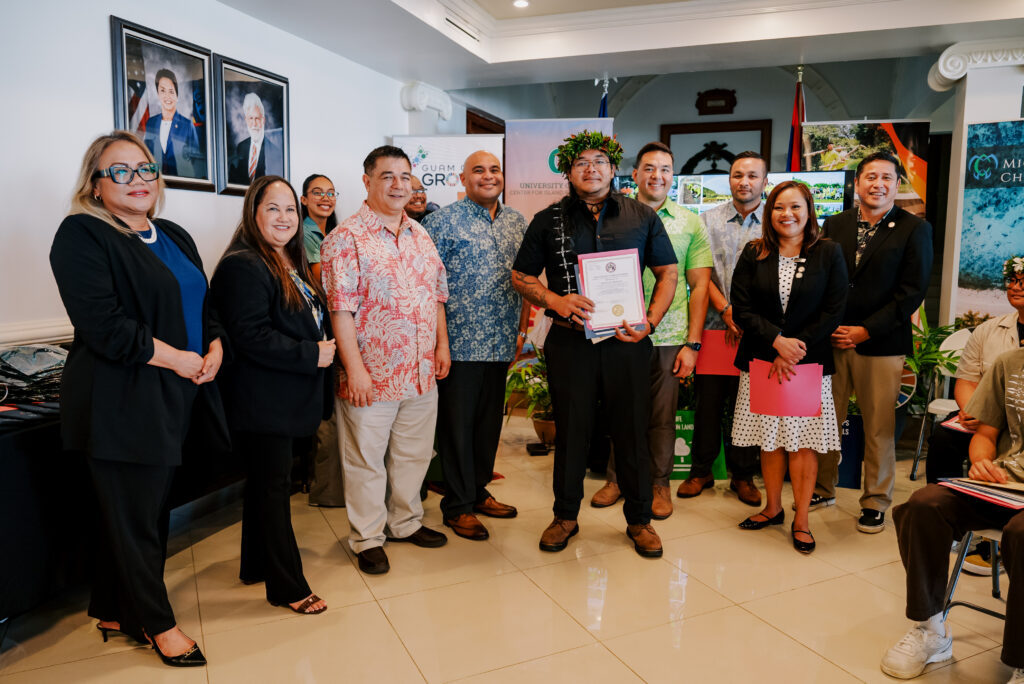
The Guam Green Growth initiative, which is facilitated by the University of Guam Center for Island Sustainability and Sea Grant (UOG CIS & Sea Grant), held a completion ceremony this month at the Government House in Agana Heights. For the first time, the Conservation Corps received certificates not only from UOG but also from the Governor’s Office, the Guam Legislature, and representatives from the Mayors’ Council of Guam.

“Make an impact,” Austin Shelton, Ph.D., director of the UOG CIS & Sea Grant, urged the cohort to make their careers more than just jobs.

“Whether you go into specific green economy jobs or go back to some of the industries that you came from— in the business sector, in HR, in administrative work, the food and beverage industry, or in the tourism industry—whatever you choose, you now have a special set of skills that are going to transform you for the rest of your lives but also transform our island,” he said.

UOG Senior Vice President and Provost Sharleen Santos-Bamba, Ph.D., highlighted how past graduates are already driving change across Guam.

“We have past graduates who are in government, in the private sector, who are entrepreneurs, or who have gone on to advance education,” Bamba said. “What that tells me is that they took those experiences and that knowledge and are now circulating it in those different spaces. So keep that in mind as you take your next steps forward,” she told the corps.

Lieutenant Governor Joshua Tenorio applauded the support of the families of the members who he hoped got to share in the experience.

“I hope that as we celebrate you in front of your families, that they get a little bit more understanding of what you’ve been doing,” said Tenorio. “I think that at the end of the celebration, they’re going to take away a lot of pride knowing that their loved one is on a mission and with a purpose to make Guam better.”

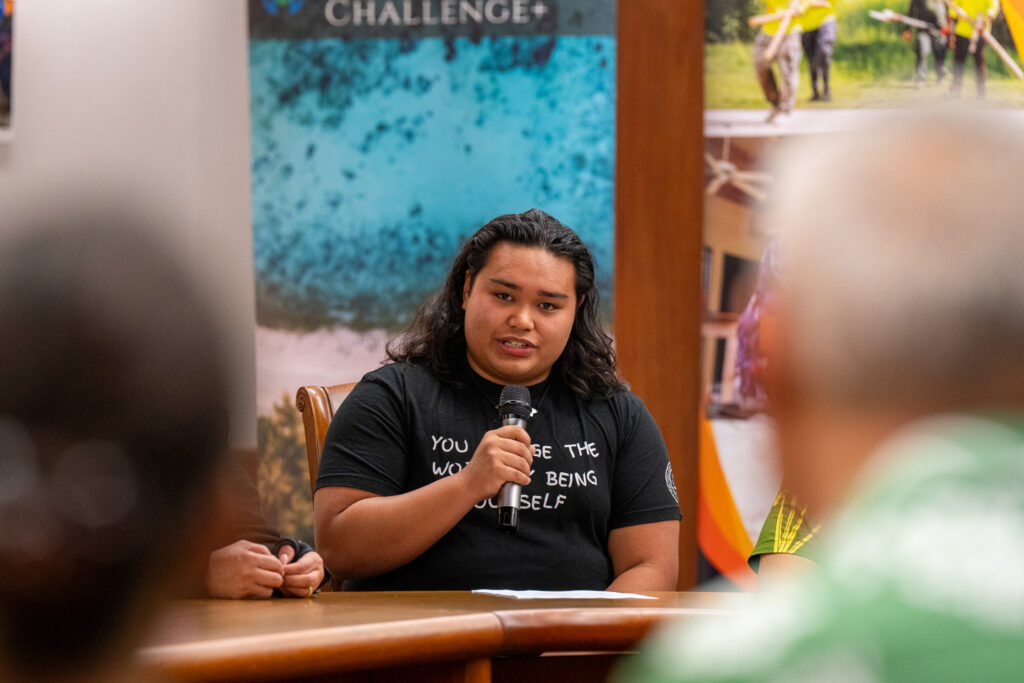
Season 5 class-elected speaker Eyana Pereda shared how the program reshaped her perspective.

“It’s one thing to know about an issue and care about it … but nothing compares to being a part of [a solution to the problem] firsthand,” Pereda said. She recalled her G3CC experience assisting in sorting of waste—she said this is where the constant influx of waste revealed “the reality of our broken system.”

The experience, she said, made her rethink how she consumes and disposes of trash daily. “What was the great thing about being a part of this corps? We were brought onto this team to work towards a better Guahan,” Pereda said.

G3 Kupu Conservation Corps Season 5 Graduates:

  1. Christian Arriola
  2. Curtis Robert Bukikosa
  3. Joshua Cepeda
  4. Marrae Cruz
  5. Mi’yah Max
  6. Eyana Pereda
  7. Matthew Pangelinan
  8. Nicolas Quinata
  9. John Reynold
  10. Gideon Tyquiengco
  11. Carl Del Rosario
  12. Tristan Ruway

Kyle Mandapat, MBA, associate director for communications and community engagement at UOG CIS & Sea Grant, emphasized the program’s growing momentum.

“This program has been going for five seasons strong thanks to the support of our legislature, the governor’s office, and UOG leadership,” Mandapat said. “Today, about 85 percent of our graduates have moved into green economy jobs or have returned to higher education.”

According to Mandapat, G3 hopes to launch recruitment for the sixth season this December. Mandapat credited the hard work of the UOG CIS & Sea Grant Community Engagement Team, led by Annania Nauta-Kemp, and the amazing line of community partners and host sites with the continued success of the program.

Upon completion, participants received a stipend and the opportunity to earn up to 80 continuing education units (CEUs) from UOG Global Learning and Engagement. They also gained hands-on experience with a wide range of environmental organizations and initiatives across Guam and the broader Micronesia region.

More information about the work of season five and the upcoming sixth season can be found online at guamgreengrowth.org.

UOG, G3 start Sustainable September with proclamation highlighting partnerships for the SDGs

Uncategorized

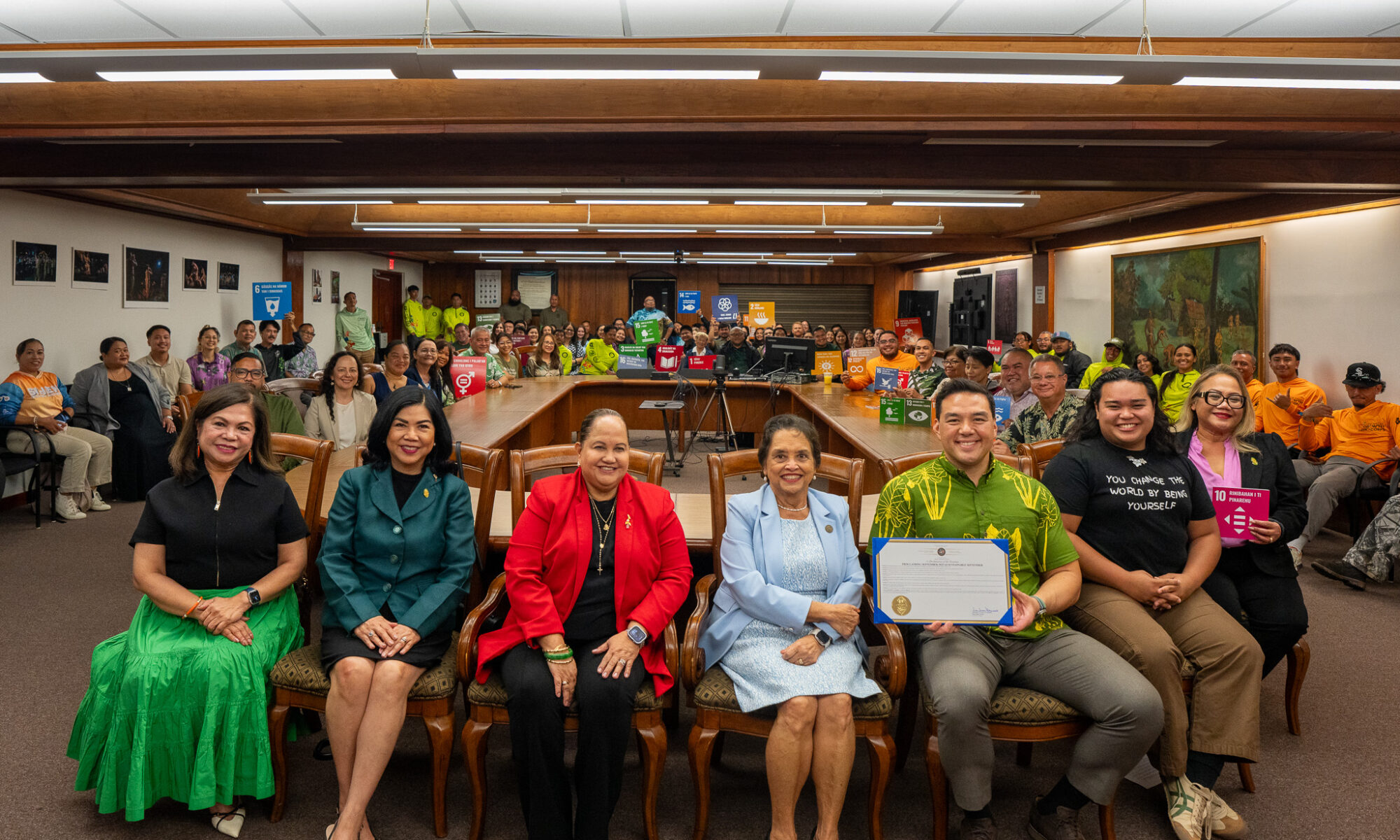
The University of Guam, Guam Green Growth (G3), and partners launched Sustainable September with a proclamation signing, highlighting the multi-sectoral efforts that laid the foundation for the islands’ progress in achieving the 17 United Nations Sustainable Development Goals (SDGs) by 2030.

Sustainable September’s month-long activities are organized by G3 and the UOG Center for Island Sustainability and Sea Grant, including the proclamation signing at the Governor’s Complex in Adelup.


At the signing, UOG President Anita Borja Enriquez, DBA, lauded G3’s efforts in pioneering an initiative that promotes collaboration in attaining the UN SDGs, saying that sustainability is a collective responsibility.


“It is not just a concept but really it is a movement. We have seen this through the collective efforts of our partners across government, nonprofit, private sectors, and individuals, and how through the efforts of the Guam Green Growth initiative, we are building capacity in the workforce,” Borja Enriquez said.


Enriquez co-chairs the G3 initiative alongside Gov. Lou Leon Guerrero, who also remarked on the momentum of the G3 movement in creating greater sustainability not only on Guam but in the region by partnering with other island jurisdictions. The Governor mentioned the recently created Green Growth initiatives in the Marshall Islands, Palau, and the Commonwealth of the Northern Mariana Islands as examples.


Meanwhile, UOG Center for Island Sustainability and Sea Grant Director Austin Shelton, Ph.D., emphasized that sustainability has always been part of the way island communities lived and interacted with each other, “For 4,000 years, sustainability has been ingrained in island life. That’s why we are making a significant impact in everything we do; sustainability is interdisciplinary, and everyone has a role to play.”


UOG Center for Island Sustainability and Sea Grant Associate Director for Communications and Community Engagement Kyle Mandapat, MBA, stated that in addition to the signing of the proclamation, Sustainable September’s month-long activities feature a lineup that highlights these multi-sectoral partnerships, including tree-planting events organized by the Guam Restoration of Watersheds (GROW) initiative at the Ugum watershed.


Other activities lined up for the month:

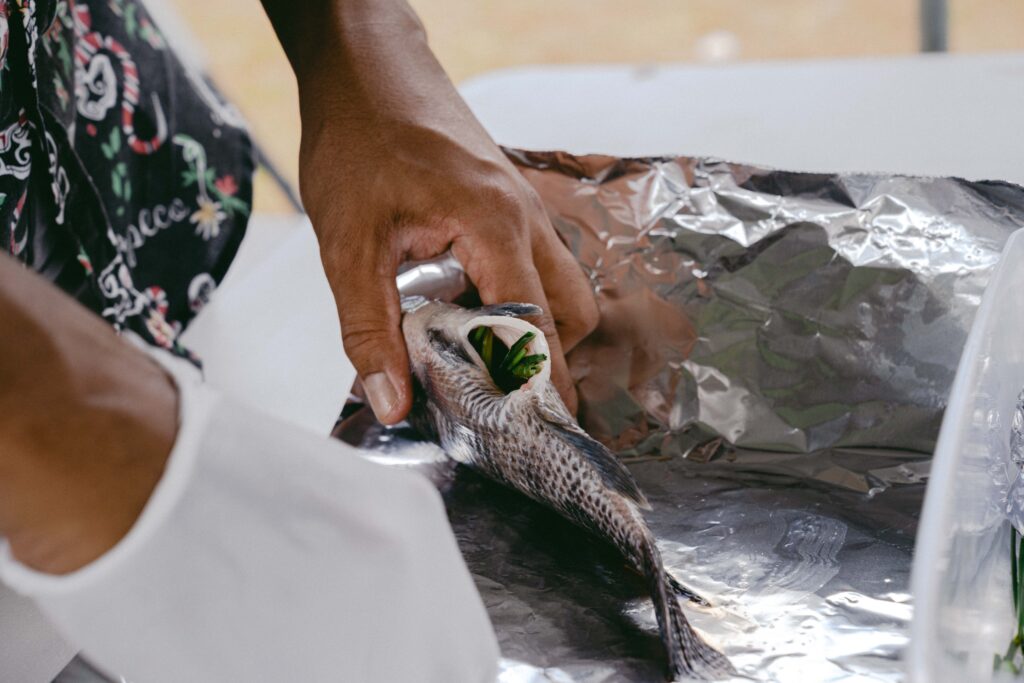
· Sept 17 – Maila Ta Fan Chesa, hosted by the Micronesian Chefs’ Association in partnership with the American Culinary Federation and the UOG Center for Island Sustainability and Sea Grant. The event, which will be held at the Hyatt Regency Guam, will feature locally sourced ingredients and fish from UOG Sea Grant’s aquaculture systems, with proceeds supporting local culinary students.

· Sept 20 – Guam’s 31st International Coastal Cleanup, starting 6:30 AM. The Guam Coastal Management Program organized the event. G3 and the UOG Center for Island Sustainability and Sea Grant. will be assisting at the cleanup sites in Adelup and Andersen Air Force Base.

· Sept 20– Sustainable Aquaculture Workshop, from 3–5 PM. Guåhan Sustainable Culture will host the workshop at the GSC Food Resiliency Hub in Yona (former Hamamoto Gardens).

· Makerspace Workshops for September:

o Sept 25 – 3D Modeling & Printing Workshop, from 5 to 7 PM, at the G3 Makerspace and Innovation Hub.

o Sept 25 – Printmaking workshop, from 5 to 7 PM, with Joey Certeza at the G3 Makerspace and Innovation.

Sustainable September activities support the 2030 Agenda for Sustainable Development, which was adopted by the UN in 2015. This plan highlights the urgent need to address key global sustainability challenges before the 2030 deadline for achieving the 17 UN SDGs.

Guam’s commitment to achieving the SDGs by 2030 was firmed up when it became a founding member of Local2030 Islands Network in 2019. This network provides an island-led, peer-to-peer platform to advance SDG progress, which eventually led to the launching of G3

MCA, ACF and UOG CIS and Sea Grant announce teams and special ingredients for Maila Ta Fan Chesa event

Uncategorized

The possibilities are abundant as the Micronesian Chef’s Association (MCA), the American Culinary Federation (ACF) and the University of Guam Center for Island Sustainability and Sea Grant (UOG CIS & SG) officially announced the team members and special ingredient assignments for this year’s Maila Ta Fan Chesa event to be held next Thursday, September 17, at the Hyatt Regency Guam.

The biggest culinary event on Guam, Maila Ta Fan Chesa, will showcase the work of local chefs, working with local ingredients grown by local farmers.

MCA President Chef Peter Duenas said that the goal of the event is always to bring awareness to the local culinary talent and the amazing agriculture producers on Guam.

“This is what Maila Ta Fan Chesa is all about,” said Duenas. “The community coming together from the farm to the table and showcasing the cuisine our island can produce every step of the way.”

According to Duenas, the teams will all prepare three courses including a special drink that will feature the special ingredient assigned to them.

This year’s slate of competitors is lined with experienced masters and budding up-and-comers from some of the most lauded establishments on the island.


The Official Line Up:

Team Dusit Thani Resort

Members: Chef Ron Villoria, Chef Kevin Sun, Chef Eliza Manacmul & Chef Craig Camacho

Special Ingredient: Limon CHamoru (CHamoru Lemon), grown by Frank Santos Jr. from Ordot-Chalan Pago


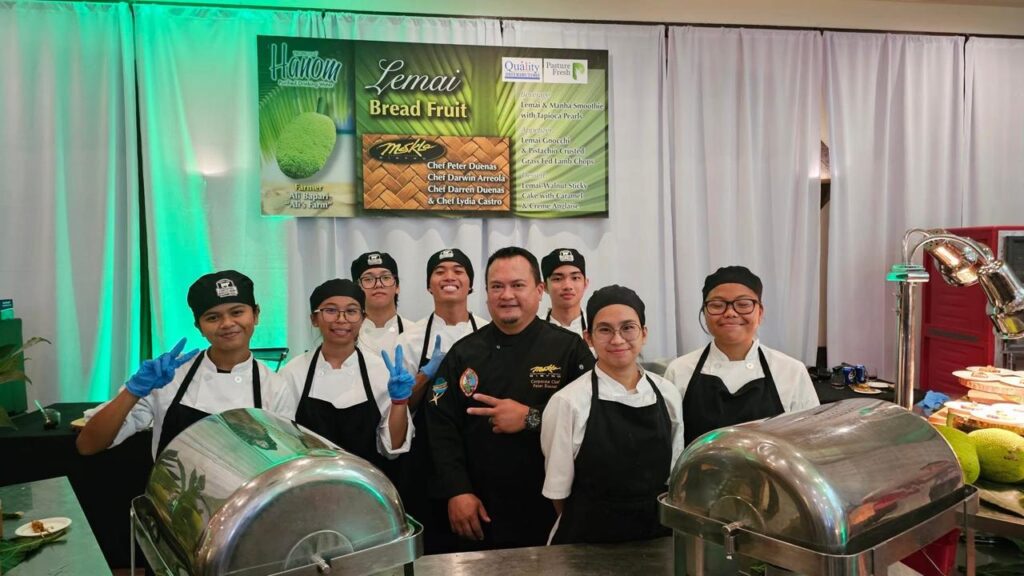
Team Meskla Restaurants

Members: Chef Peter Duenas, Chef Darwin Areolla, Chef Darren Duenas & Chef Lydia Castro

Special Ingredient: Niyok (Coconunt), grown by Joseph Paulino from Inalahan


Team Hyatt Regency Guam Resort

Members: Chef Xavier Mcentee, Chef Phillip Lopez & Chef Mina Aflague

Special Ingredient: Donne’ (Hot Pepper), grown by Glen Tamar from Talo’fo’fo


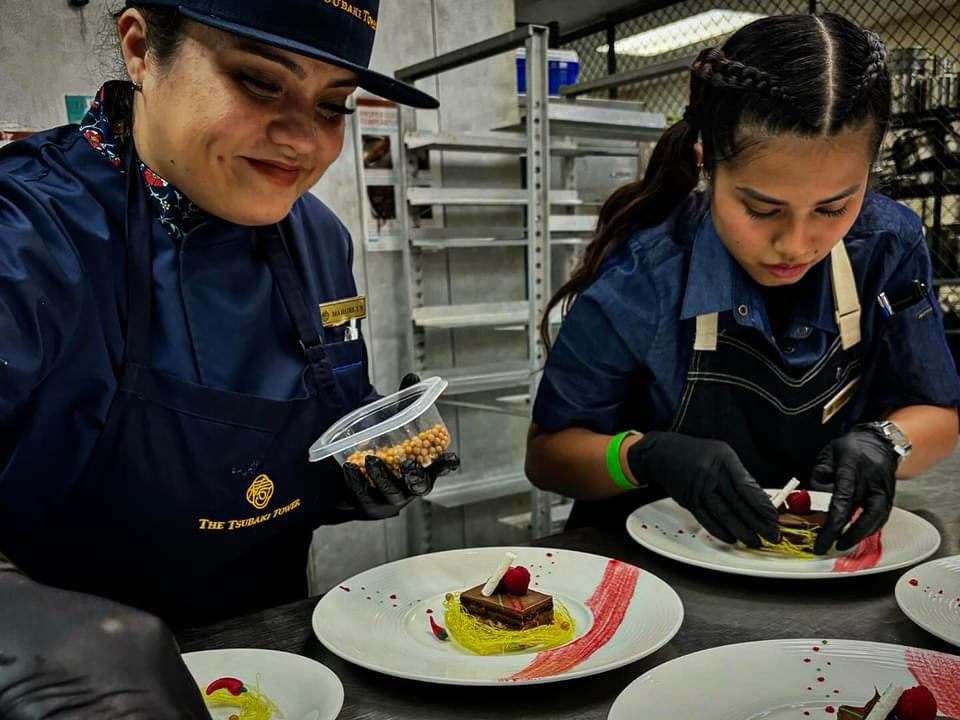
Team Tsubaki Tower

Members: Chef Marvin Nuezca, Chef Margelyn Birr & Chef James Tamngug

Special Ingredient: Lemmai (Breadfruit), grown by Bill McDonald from Agana Heights


Team GCC/Prostart

Members: Chef Dylan Borja, Chef Ashley Castaneda, Chef Zion Manibusan, Chef Ricamel Macaranas, Chef Jasmine Enriquez & Chef Rica Sarmiento

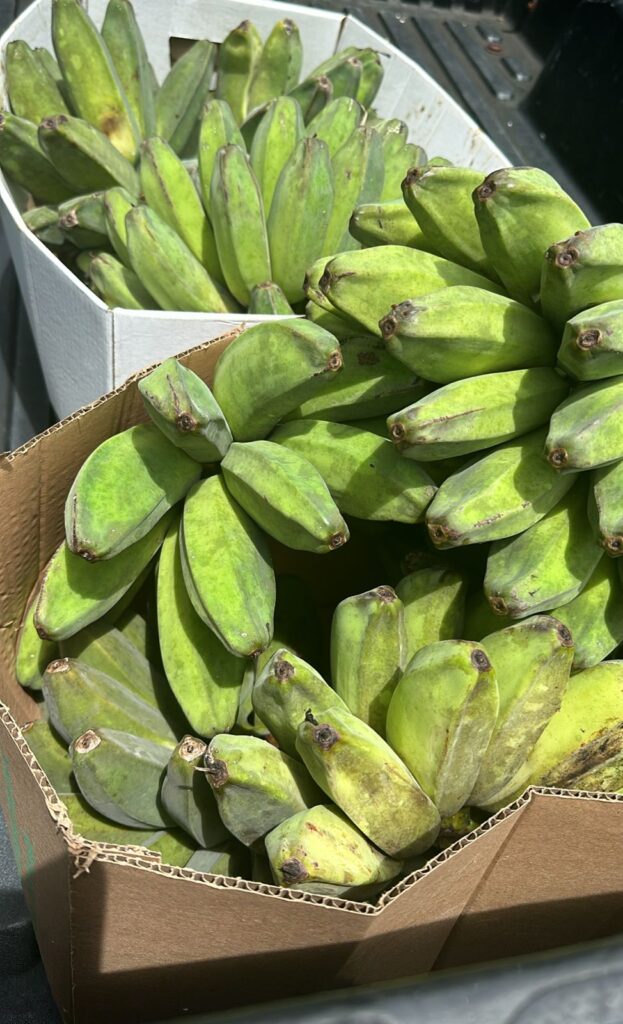
Special Ingredient: Aga’ (Cooking Banana), grown by Ken Aguon from Talo’fo’fo


Team Primo Pizzakaya

Members: Chef Dylan Saad, Chef Kelly Simmons & Chef Rob Rhoden

Special Ingredient: Mansanita (Local Cherry)


Along with the special ingredients, teams will also have a chance to incorporate aquaculture grown on Guam through the UOG CIS & Sea Grant aquaculture systems.

“We are excited to showcase a full range of locally grown fish, fruits and vegetables during this year’s Maila Ta Fan Chesa,” said Austin Shelton Ph.D., the director of the UOG CIS & Sea Grant. “The work the MCA is doing to help increase culinary capacity on our island through their mentorship and development programs also helps us to address food security through the inclusion of aquaculture in this process.”

The MCA and ACF work with various groups throughout the community to bring this experience to the island including the UOG Cooperative Extension team out of the College of Natural and Applied Science who work with and facilitate the connections with the local farmers from all around the island.

Tickets for the event are available now for $85 at IDI, Meskla, Tools of the Trade and from MCA members. Each ticket comes with entry, full access to the culinary offerings, special drinks, and a chance to win a free circulating aquaponics system. Doors will open at 6pm after a short welcoming ceremony and the event will last until 9pm.

UOG’s Guam Green Growth and Yoña mayor’s office team up for cliff side tree planting project

Uncategorized

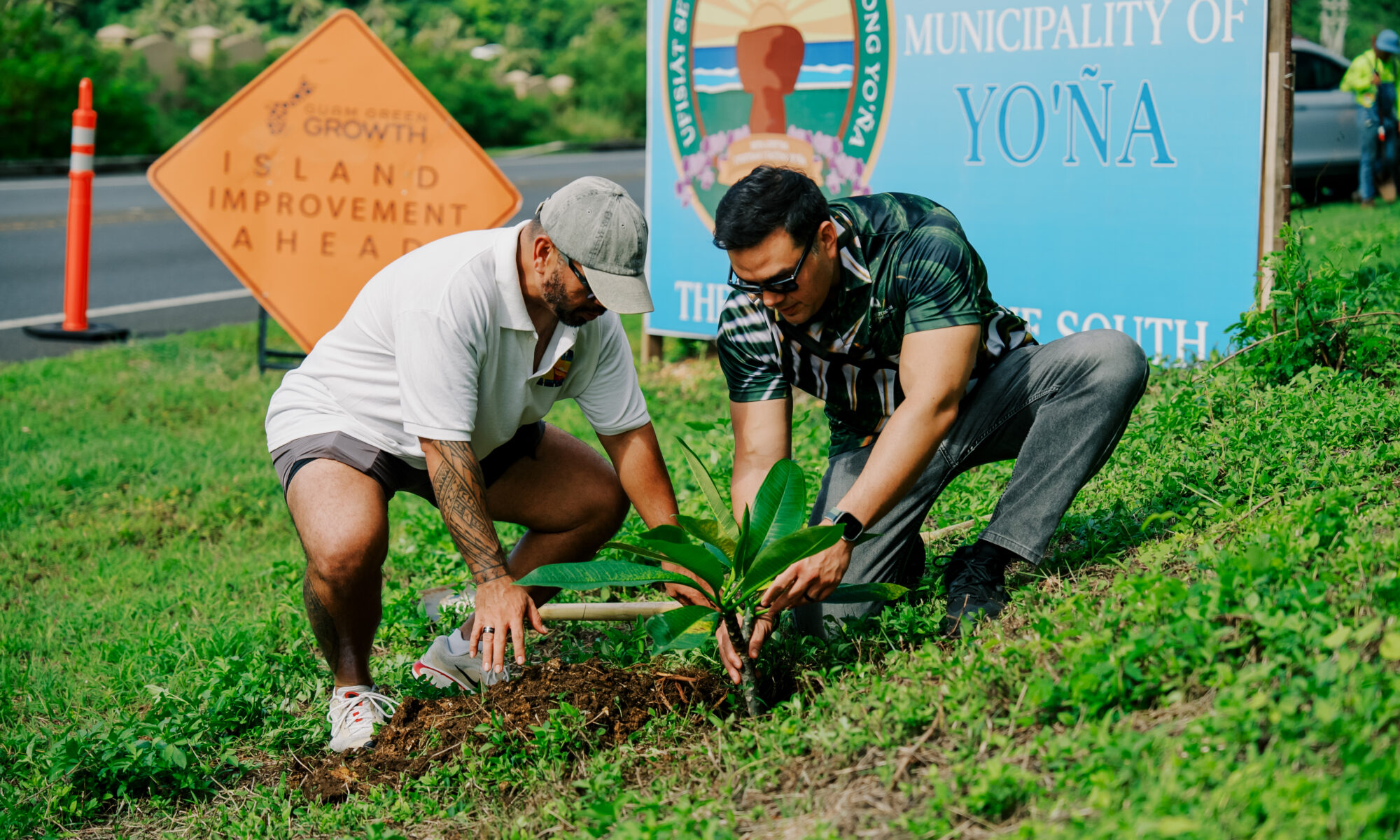
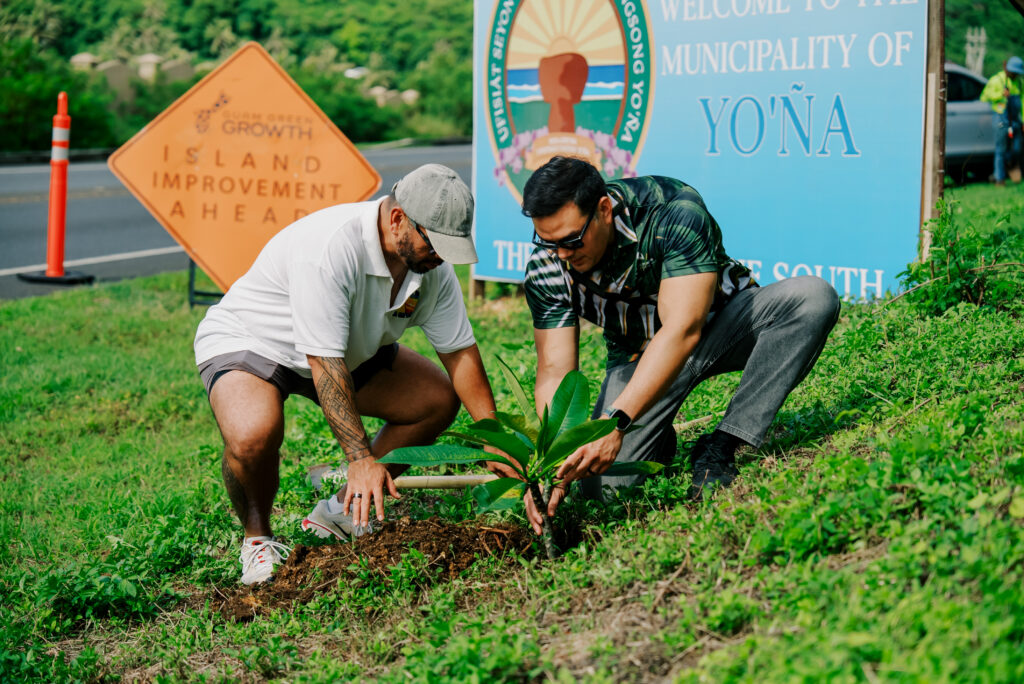
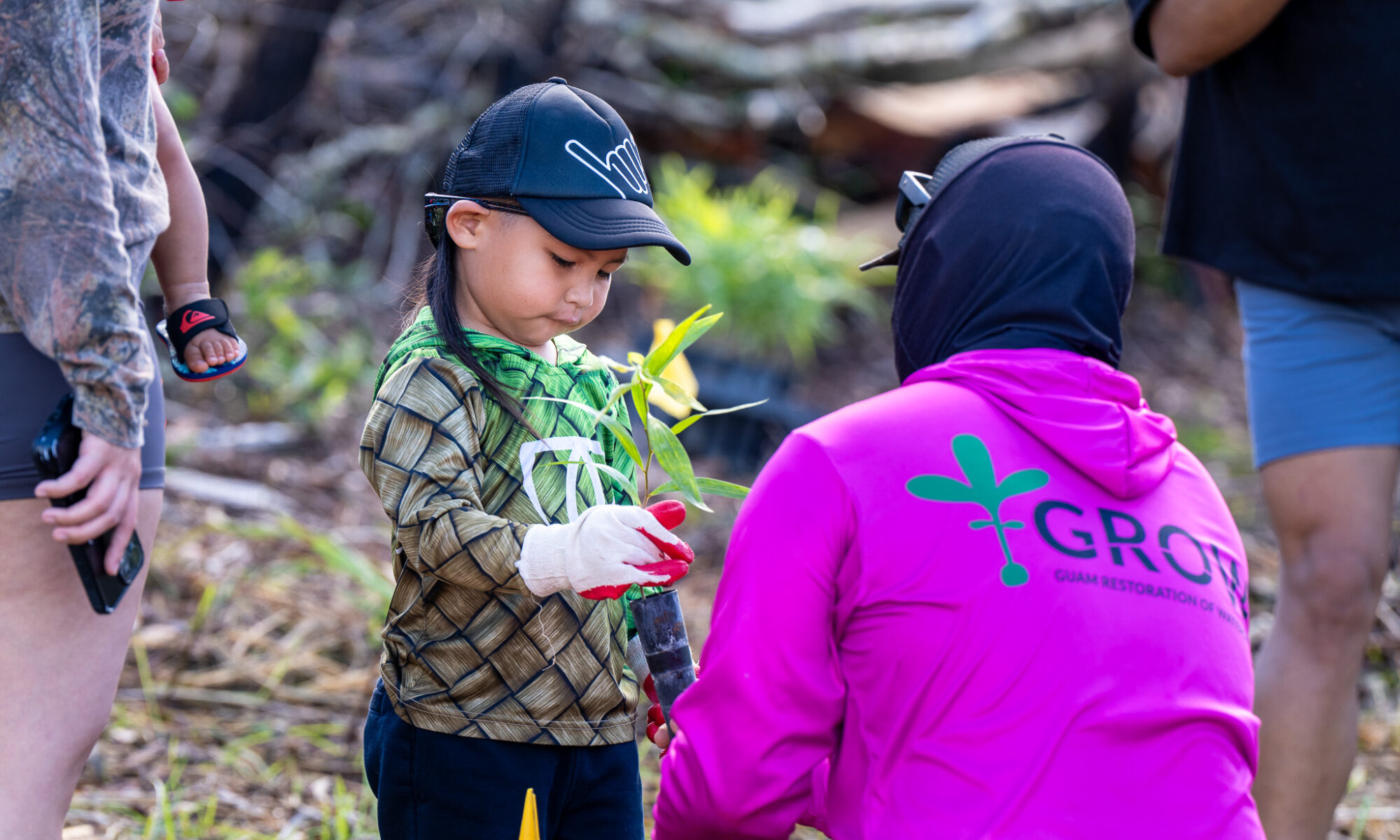
In the spirit of community collaboration, the University of Guam’s (UOG) Guam Green Growth (G3) initiative and the Yoña mayor’s office planted 34 plumeria trees along the Yona cliff line as part of ongoing island beautification efforts.

Members of the G3 Conservation Corps, the G3 GROW Corps, community volunteers along with Mayor BJ Terlaje and his team, aimed to enhance the natural beauty of the area with the planting.

“I’ve always dreamed of Yona being the gateway to the South, where you’ll see all these plumeria trees blossoming,” Terlaje explained to volunteers. “What you’re doing is a positive thing. We’re opening up the eyes and ears of our community that has been stagnant for a very, very long time.”

Participants carefully selected and planted each of the plumeria trees, a species known for its fragrant blossoms and resilience, which are well-suited for Guam’s climate.

Austin Shelton Ph.D., the co-chair of the G3 steering committee and the director of the UOG Center for Island Sustainability and Sea Grant reflected on the lasting impression and impact the planting will have for the community.

“A sustainable future is a beautiful future. We’re grateful to the hardworking volunteers who planted these trees as a stunning and fragrant legacy for our community and visitors to enjoy,” said Shelton.

The newly planted plumeria are expected to grow and flourish, providing a lasting, fragrant landscape.

Over the course of the G3 Conservation Corps’ six-month program, they will have hosted island beautification events in every village on Guam. Successful events have included roadside and beachside trash cleanups, illegal dumpsite restoration, bus stop and facility paintings, tree plantings and more.

More information on the Corps and other G3 implementation projects can be found on www.guamgreengrowth.org and via @guamgreengrowth on social media.

Micronesian Chefs’ Association’s Maila Ta Fan Chesa returns to celebrate local chefs and cuisine, welcomes American Culinary Federation and UOG for aquaculture spotlight

Uncategorized

The Micronesian Chefs’ Association (MCA), in partnership with the American Culinary Federation (ACF) and the University of Guam Center for Island Sustainability and Sea Grant (UOG CIS & Sea Grant), is excited to announce the return of the Maila Ta Fan Chesa event on Wednesday, September 17, 2025, at the Hyatt Regency Guam.

After a successful comeback last year, this year’s culinary showcase will continue to highlight the incredible talent of Guam’s local chefs, with teams creating dishes highlighting locally sourced ingredients. The event, which means “come, let’s have some appetizers” in CHamoru, is a celebration of the island’s unique flavors and culinary traditions.

“We are excited to be back with this year’s Maila Ta Fan Chesa where we’ll be sharing new elements and our new partnerships with the American Culinary Federation and the UOG CIS and Sea Grant. I’m confident that the new elements will bring this year’s event to the next level,” said Micronesian Chefs’ Association President Peter Duenas. “We are working with some of Guam’s Top chefs and their teams, ready to bring creative flavors and style for the event and attendees. You don’t want to miss this one!”

A new addition to this year’s event is a special spotlight category dedicated to locally grown and raised aquaculture. This category, supported by the UOG CIS and Sea Grant, aims to showcase the potential of sustainable aquaculture in enhancing Guam’s food security and promoting a circular economy.

“UOG CIS & Sea Grant is honored to partner with the MCA and ACF on this iconic event,” said Director of the UOG CIS & Sea Grant Austin Shelton Ph.D. “Along with the amazing local ingredients from all around the island, the event will feature of locally aquacultured fish to give everyone a sense of how our island can be more sustainable and increase our food security.”

Attendees will also be automatically entered to win their own circulating aquaponics system that can help them start growing their own fish and vegetables, valued at $3000, for free.

Teams Include:

Meskla
Hyatt Regency Guam
Dusit Thani Resort Guam
Primo Pizzakaya
The Tsubaki Towers
John F. Kennedy High School ProStart team
Guam Community College ProStart team

“This event is about showcasing local talent, and helping to develop new local talent,” explained MCA member Mirko Agostini, executive chef of the Hyatt Regency Guam. “Coming to this event will help us to continue to provide programs and support for the up-and-coming chefs and students interested in culinary here on Guam.”

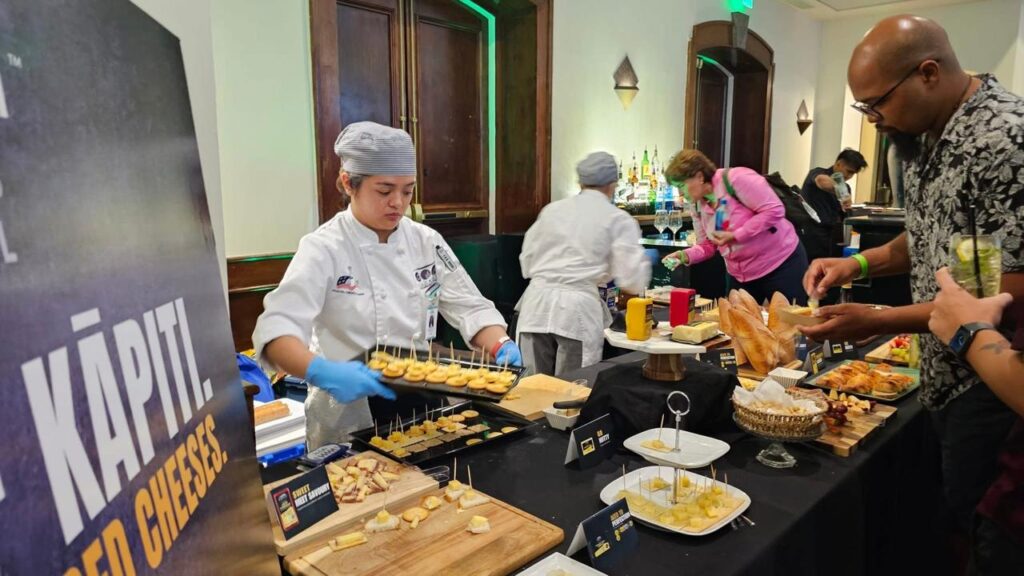
Attendees will have the chance to taste these unique creations and engage with the chefs, learning about the inspiration behind their dishes and the importance of using local ingredients.

The local ingredients and farmers to be highlighted this year include:

Bill McDonald, Agana Heights – Lemmai
Roland Santos (Farm to Table), Mangilao – Mansanita
Ken Aguon, Talo’fo’fo – Aga’
Glen Takai, Talo’fo’fo – Donne’
Joseph Paulino, Inalahan – Niyok
Frank Santos Jr., Ordot-Chalan Pago – Limon CHamoru


Tickets are available now for $85 at Meskla, IDI, Tools of the Trade, and from MCA members. The proceeds from the event will support the Micronesian Chefs’ Association’s mission to foster the next generation of culinary leaders on the island.

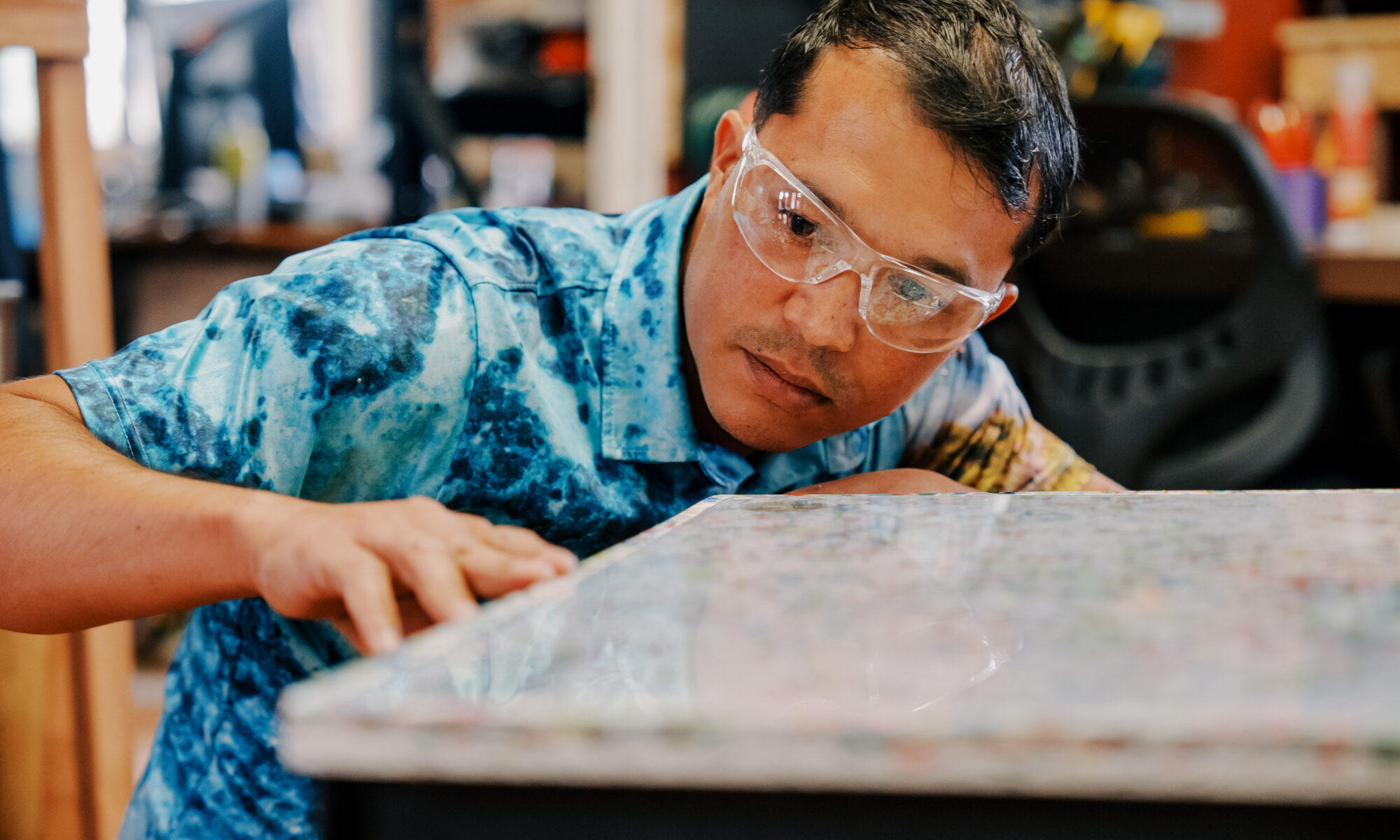
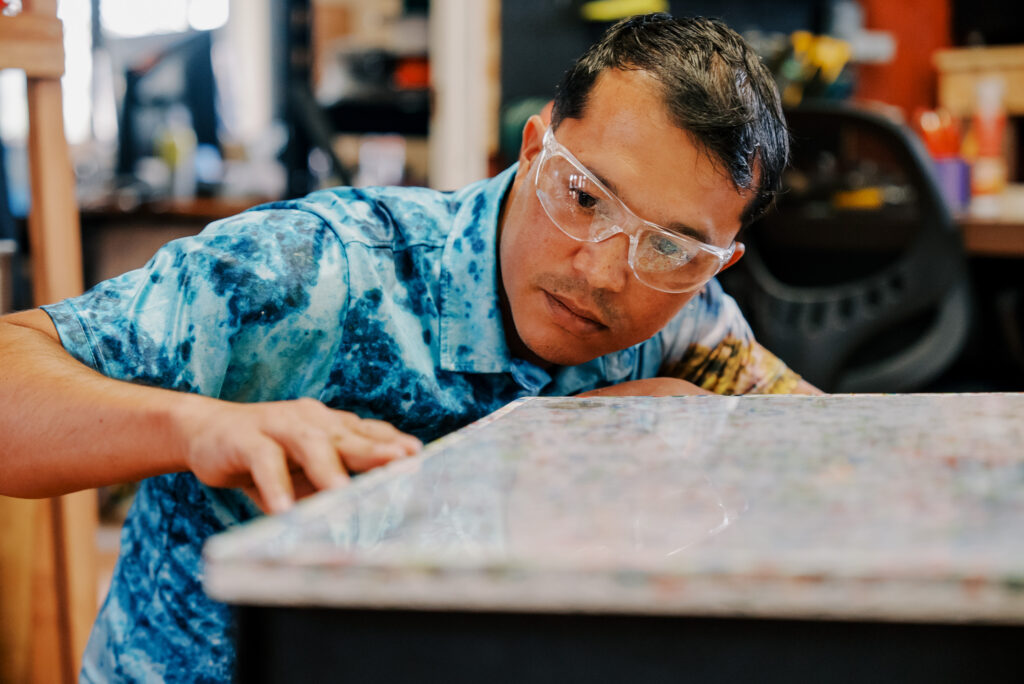
G3 Makerspace kicks off plastic collection drive to refurbish school desks

Uncategorized

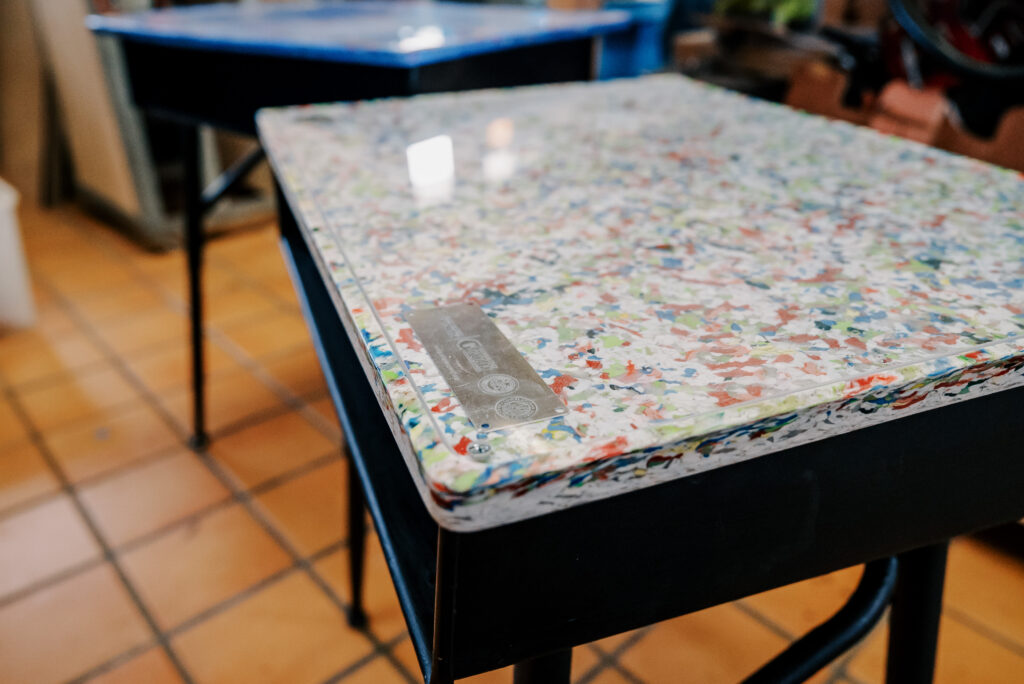
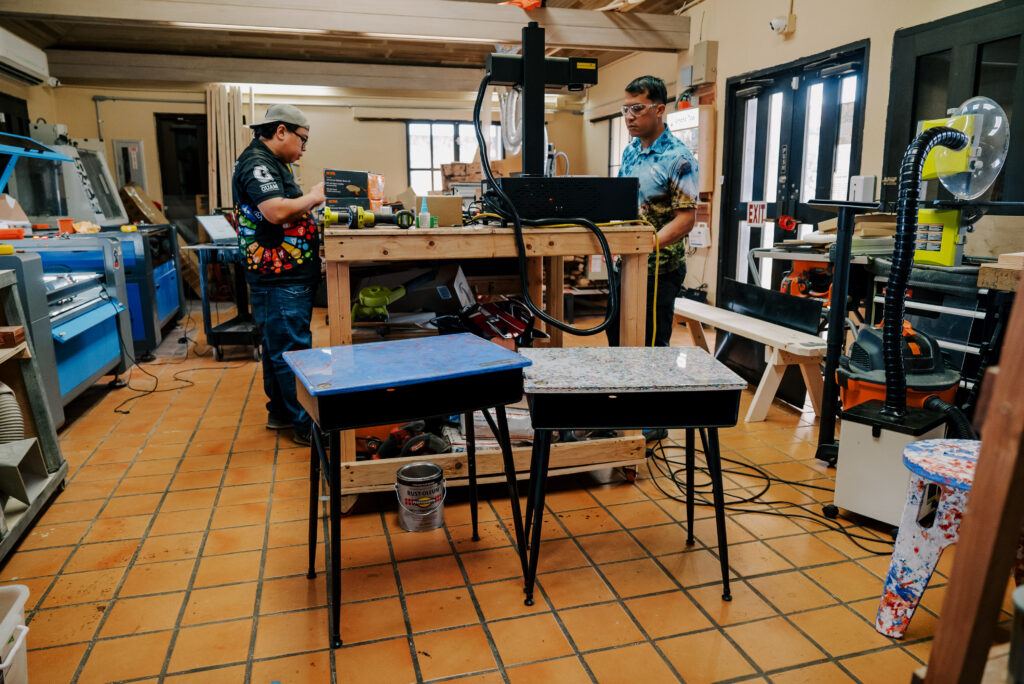
The Guam Green Growth Circular Economy Makerspace and Innovation Hub (G3 Makerspace) has started a campaign to collect recyclable plastics in support of a new project to refurbish school desks. This initiative aims to provide a sustainable solution to a common problem in schools and address a significant challenge in waste management on island.

A waste characterization report commissioned by the Guam Environmental Protection Agency (Guam EPA) and the Guam Bureau of Statistics and Planning (BSP) found that plastics make up around 25% of the island’s waste that ends up in the Layon landfill. Plastics were the second most common material found, following organic waste.

The significant volume of plastic waste that goes to the landfill highlights the importance of initiatives like this desktop refurbishment project, which aims to turn discarded materials into durable, functional products for the community, according to University of Guam Center for Island Sustainability and Sea Grant Director Austin Shelton.

“Through this project, the G3 Makerspace and Innovation Hub is helping build a waste management pipeline that transforms recyclable plastics into school desks for our students, keeping them out of the landfill and giving them new life,” Shelton said.

The initiative began earlier this year when Navigating Home fellow Justin Cruz, who is assigned to the G3 Makerspace, created a prototype for a desk using recycled plastics. Cruz revealed the desk prototype during the announcement of his fellowship, which led the G3 Makerspace to turn the idea into a full-scale project.

“A lot of our schools have poor-quality desks,” said Emily Wendte, G3 Makerspace coordinator. “The tops of the desks are made from a composite material that disintegrates, making them unsafe for kids to use. So, they end up throwing the whole desk away.”

Starting with one classroom at Maria A. Ulloa Elementary School in Dededo, the G3 Makerspace aims to complete between 30 and 50 desks, according to Wendte.

To create the new desktops, the G3 Makerspace would need two types of recyclable plastics: #2 high-density polyethylene (HDPE) and #5 polypropylene (PP). HDPE is commonly found in shampoo bottles and laundry detergent containers, while PP is used in yogurt containers and some to-go food containers.

According to Wendte, producing one desktop requires a significant amount of material. “So if we make these desktops from a 3 ft x 3 ft sheet, about three-quarters of an inch thick, that’s roughly 50 pounds of plastic for one sheet.” These plastic sheets are processed using equipment such as a shredder and an extruder machine at the G3 Makerspace & Innovation Hub.

The project has a target completion date in the first quarter of 2026. To support the effort, the G3 Makerspace is collaborating with the UOG Center for Island Sustainability and Sea Grant, UOG Residence Halls, and UOG Global Learning & Engagement to collect recyclable plastics.

“UOG is going to participate in recycling,” said Wendte. “So we’re going to recruit some dorm residents to collect plastics from the dorm, clean them, and prepare them for us to recycle.”

The desk refurbishment project is part of a larger research and product development effort at the G3 Makerspace aimed at finding innovative uses for recyclable plastics. Another project, in partnership with Ernesto Guades, Ph.D., assistant professor at the UOG School of Engineering, involves exploring how certain types of recyclable plastics can be prototyped into construction materials

How to Donate

Those interested in donating plastic containers can drop them off at the Plastic Resource Center of the G3 Makerspace and Innovation Hub (Unit 114) at the CHamoru Village. Donations are accepted every Wednesday from 3 p.m. to 8 p.m. during Night Market. For more information, call 671-683-7715.

Before Donating Containers:

Check the recycling number. Look for the number inside the recycling symbol, usually located on the bottom or back of the container.
Only #2 (HDPE) and #5 (PP) plastics are accepted. Examples include coffee containers (except lids), laundry detergent bottles, yogurt containers, and to-go food containers.
Remove all labels and clean thoroughly. Unclean plastics won’t fuse properly and could damage the machines

Collector donates thousands of shells to UOG Biorepository

Uncategorized

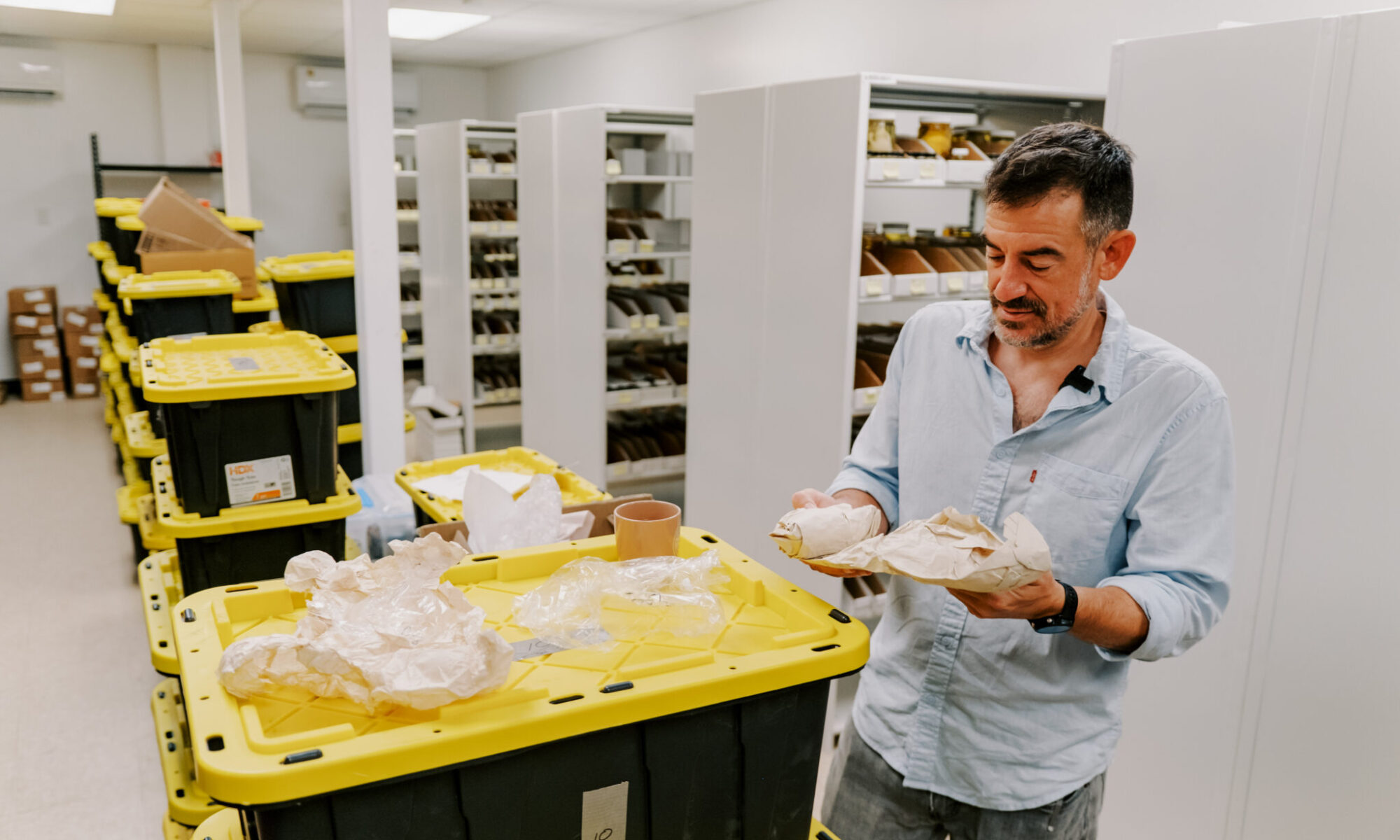
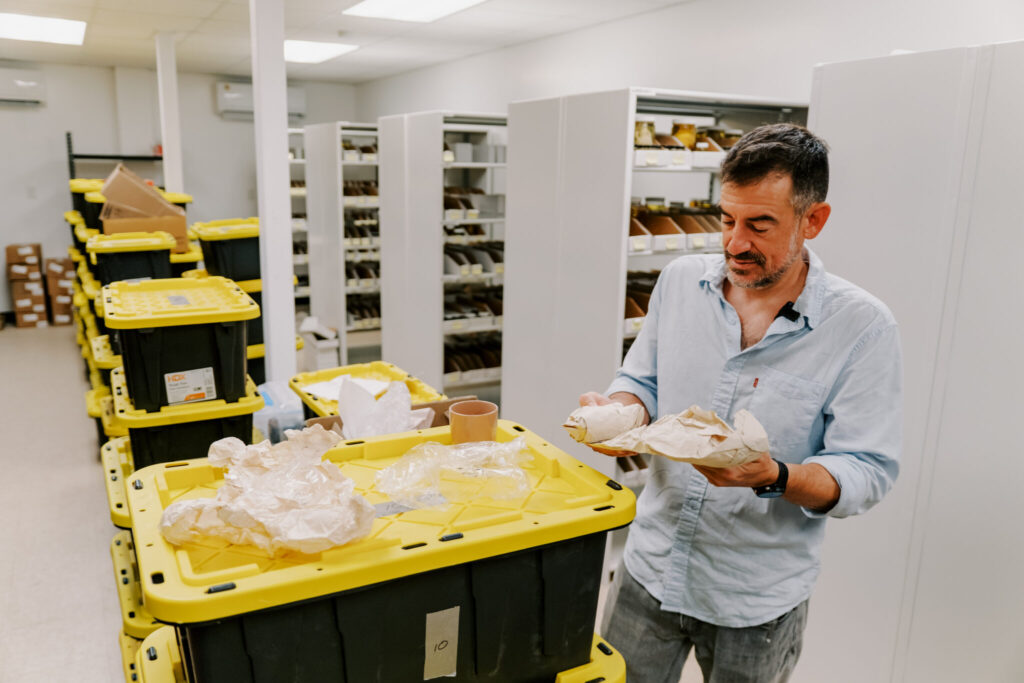
A retired shell enthusiast recently donated thousands of shells to the Guam NSF EPSCoR Biorepository at the University of Guam, many of which were collected on Guam during the 1960s, to be added to its historical collection.

Warren B. Carah, author and engineer, spent his teenage years in Guam from 1960 to 1964, where his family relocated due to his father’s service as an officer in the U.S. military. Carah attended Tumon High School, now known as John F. Kennedy High School, and spent his after-school hours searching for shells in Tumon Bay with his friends.

“We went to our lockers, got our spear guns out, and took the old Japanese elevator that went from the cliff down to the beach and we spent the rest of the day shelling, we went to just about every beach on the island,” Carah said.

Aside from Tumon Bay, Carah and his friends also frequented Apra Harbor, Malesso’, Cocos Island, and Tarague Beach in Andersen Air Force Base.

“I used to spend many, many hours out there at night. The bottom would literally be crawling with the very large cone shells, olive shells, and cowrie shells and during the day, it would look barren but at night, everything had come out,” Carah stated.

The donated shell collection includes around 4,000 shells from Guam, the Philippines, Australia, North America, and Africa.

Carah is aware of the difference in shell conservation now compared to how it was in the 1960s. “I think nowadays, most anybody that collects shells on Guam is quite aware of the fact that they have to let that resource go after they had found it, photographed it perhaps.,” Carah said, adding, “That didn’t exist in the early 1960s, but we still practiced conservation. There was no point in us collecting dozens and dozens of the same shell. We would collect one or two and our efforts would then go to find a new species.”

The Guam NSF EPSCoR Biorepository works to consolidate and expand Guam’s natural history collections and provides state-of-the-art digitization, imaging, and mapping of local and regional marine fauna and flora.

Regarding the importance of this donated shell collection, Robert Lasley, Ph.D., assistant professor and curator of crustacea at the Biorepository, describes it as “valuable for establishing a historical baseline, as well as for studying different species to better understand Guam’s biodiversity. It also allows researchers to compare what may have existed in certain localities in Guam back in the ‘60s to what is being found now.”

Carah had been sitting on his shell collection for almost 60 years before ultimately deciding to donate it to a place that can benefit from its possession.

“I sent a letter to the dean of the biological sciences group there at the University of Guam and she evidently then turned that over to Dr. Lasley, and then he contacted me via email and we’ve been corresponding ever since,” Carah said.

Lasley stated that Carah’s shell collection includes the exact day it was collected and the precise location where it was gathered. “Not only did he do these collections, but he kept a lot of good data and took really good care of them. In fact, you can see how well he packaged this stuff and sent it to us in really good condition,” he said.

The Biorepository houses thousands of coral specimens, crustaceans, fishes, algae, and other organisms to serve as an archive of the biodiversity found within the Micronesian region. Lasley explained that modern tools now allow for the collection and global dissemination of data from these specimens. He added that, eventually, all of them will be photographed, and their locality data will be gathered and entered into the curatorial database

“We’re going to get all the locality data from all these, and we’ll put them into our curatorial database, but then serve them online globally so any researcher anywhere in the world can access this information,” Lasley said.

For more information on the Biorepository and Guam NSF EPSCoR, visit the program’s official website at guamepscor.uog.edu or follow @GuamEPSCoR on Facebook and Instagram.
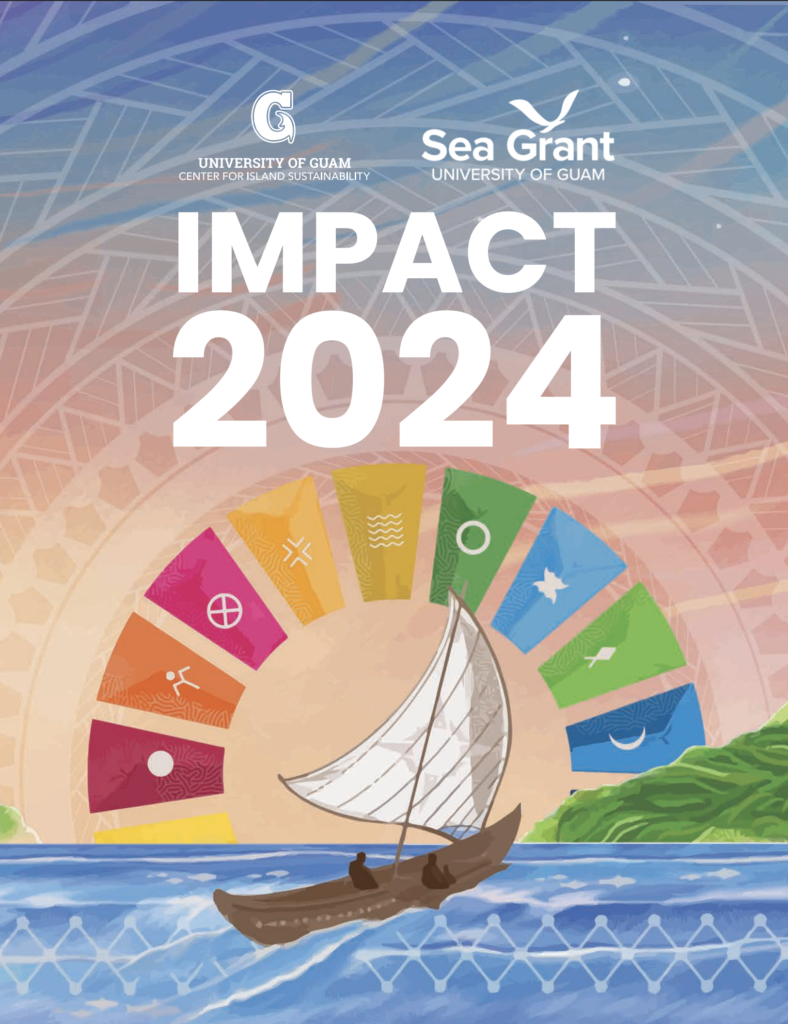
UOG unveils 2024 CIS & Sea Grant Impact Book, showcasing project progress and over 33x ROI on local funds

Uncategorized

The University of Guam’s Center for Island Sustainability and Sea Grant (UOG CIS & Sea Grant) program today announced the release of its 2024 Impact Book, chronicling a year of significant progress in sustainable development. The report highlights major initiatives including record breaking progress in the Sea Turtle Management program, Guihan for Guahan, the Guam Restoration of Watersheds (GROW) and more.

Along with the announcement of numbers the group has collected over the course of the 2024 calendar year including over 12,000 outreach activity participants, nearly 150 recorded sea turtle nesting events, 59 students supported through fellowships, was a report of the return on investment of local funds allocated to the organization.

“In 2024, the University of Guam Center for Island Sustainability and Sea Grant delivered a 33.9 time Return on Investment (ROl) – for every $1 in funding we received from the local budget,” explained Austin Shelton Ph.D., the director of UOG CIS & Sea Grant. “Through the many grants we applied for and were awarded, we were able to leverage $33,900,000 in total funding for our island.”

The report highlights the biggest events and initiatives of 2024 in the UOG Conference on Island Sustainability and the launch of the CHalan Deskubre Hub learning center at the Mangilao campus but also provides some insight into ongoing projects including the move to pursue Gold Standard Carbon Credit Certification with the US Climate Alliance, for GROW reforestation projects. This pioneering strategy is designed to create a sustainable revenue source, allowing conservation work to continue for years to come, independent of traditional grant cycles.

“The projects featured in this year’s Impact Book demonstrate our commitment to developing practical, innovative, tangible and sustainable solutions for our island,” said Kyle Mandapat, Associate Director for Communications & Community Engagement at UOG CIS & Sea Grant. “From protecting our coral reefs through reforestation to inspiring our youth through hands-on science education, we are not just showing you what has been done but welcoming the community to participate in efforts as well.”

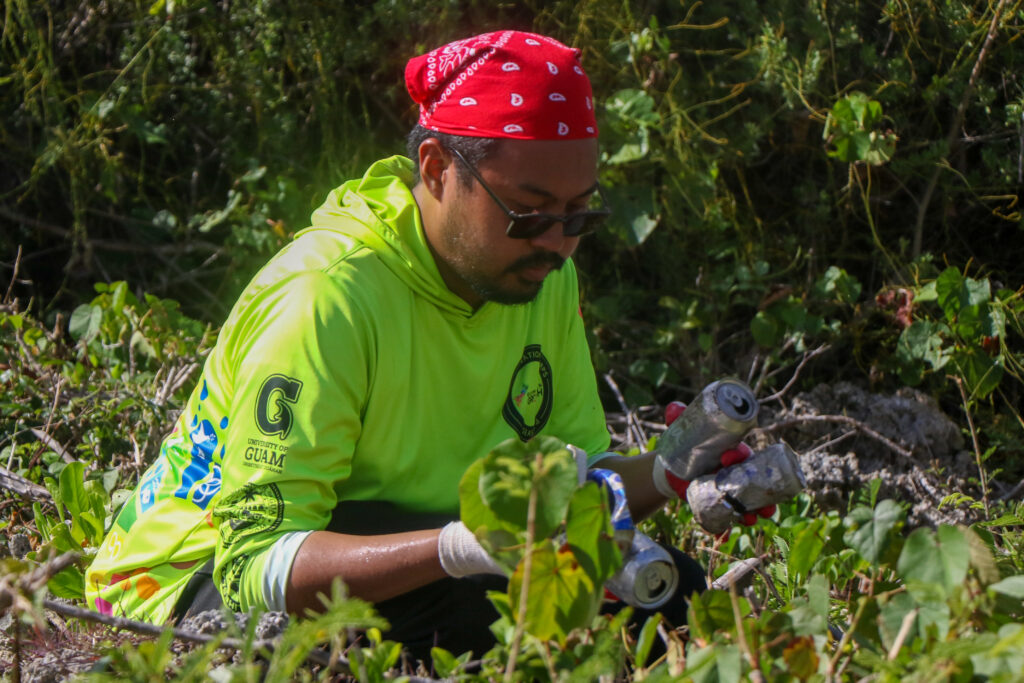
The Guam Green Growth Conservation Corps (G3CC) impacts are also revealed for the season with over 13,000 aluminum cans diverted from the landfill by recycling, 14 roadside cleanups being conducted and 200 feet of erosion control devices being installed. The workforce-development program, now in its fifth season, continues to add to growing success with around 80% of the nearly 60 G3CC program graduates finding jobs in the green economy.

“I am proud to present the 2024 Impact Report from the UOG Center for Island Sustainability and Sea Grant. The accomplishments outlined in this report reflect the university’s unwavering commitment to sustainability and our growing leadership in research, education, and outreach for Guam and the broader Micronesian region,” said Anita Borja-Enriquez D.B.A., president of the University of Guam.
The 2024 Impact Book can be found for free digitally at uog.edu/cis under the resources tab along with other publications from the group including posters, calendars, and books.

G3CC Dives into Fisheries Management at Week-Long Workshop

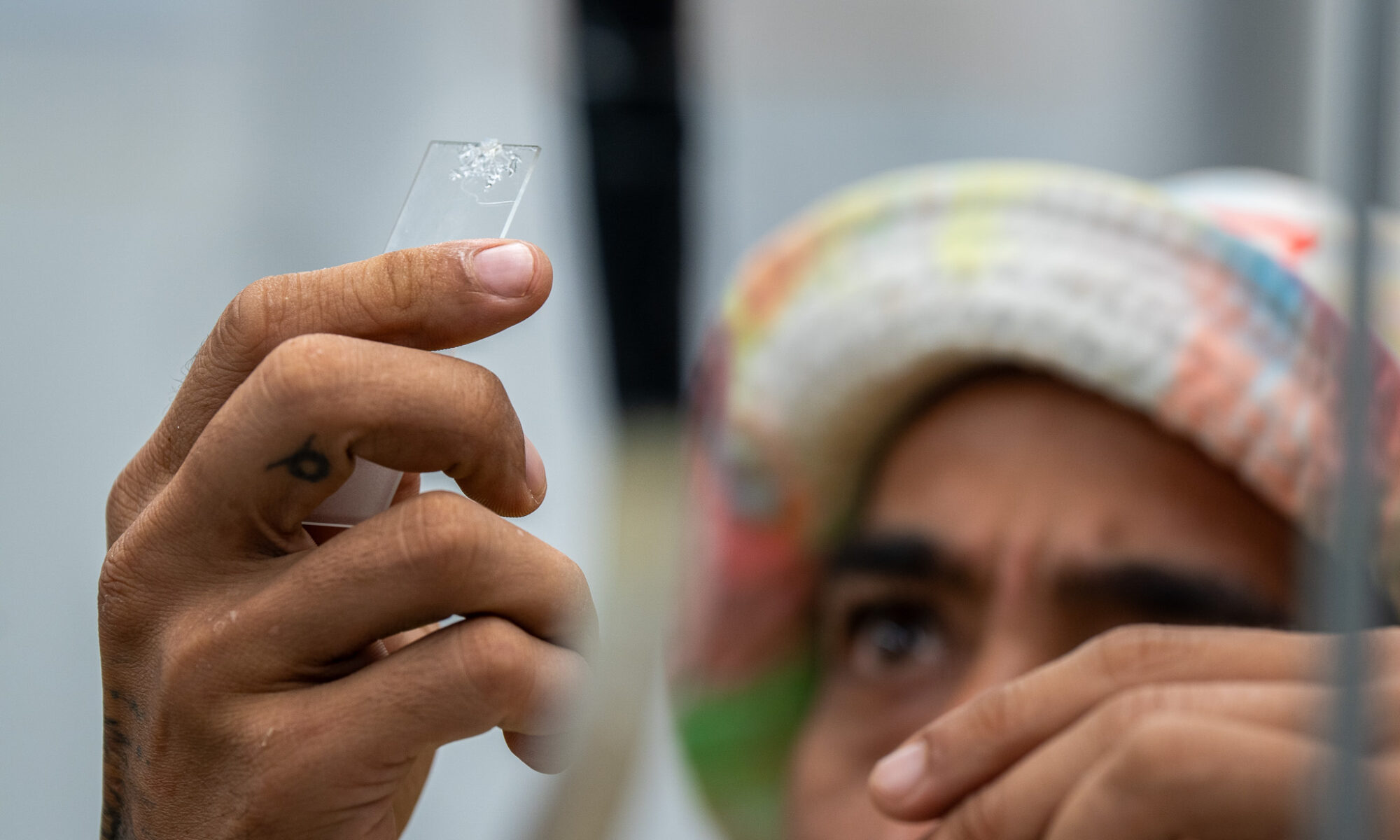
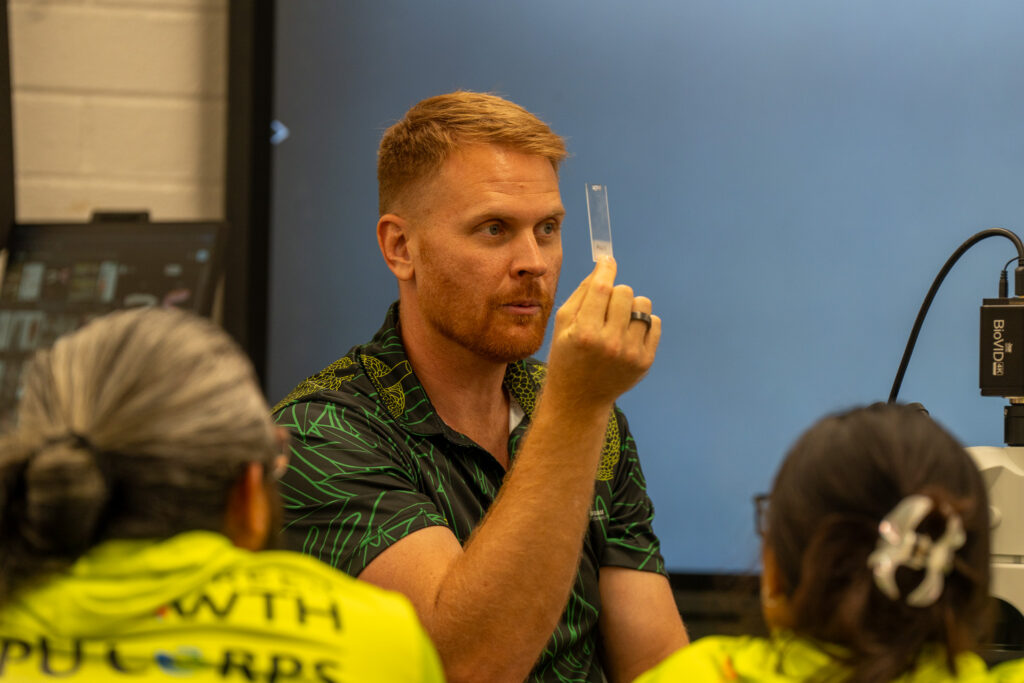
A close-up of man holding small glass slide containing a tiny specimen.

Uncategorized

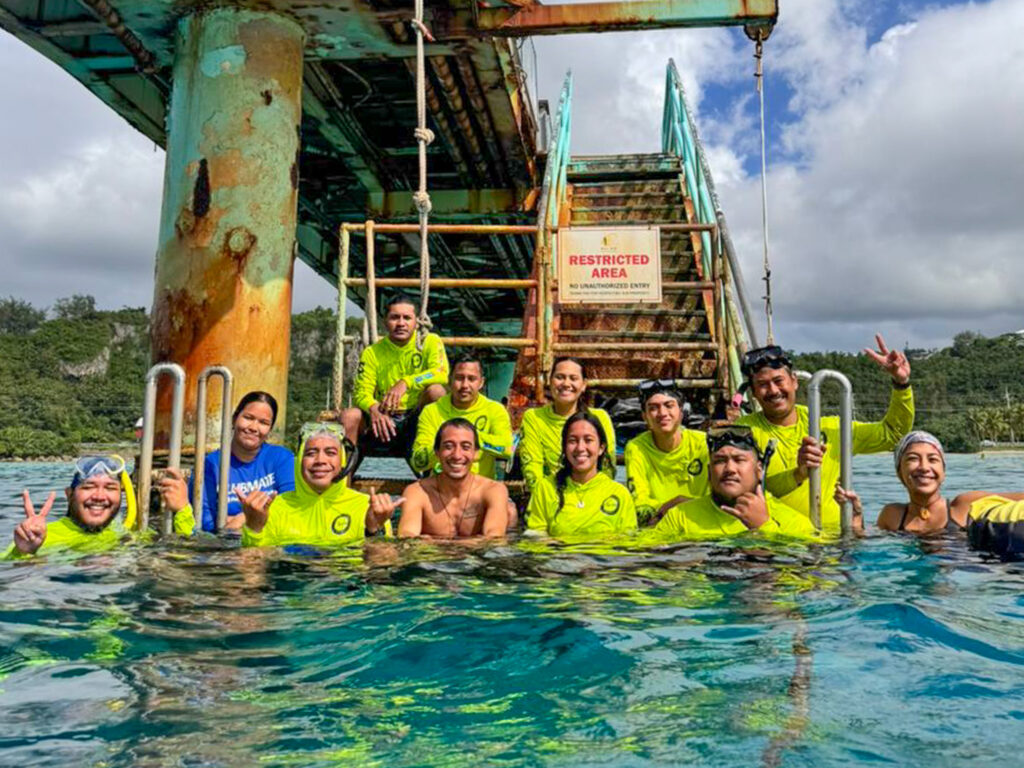
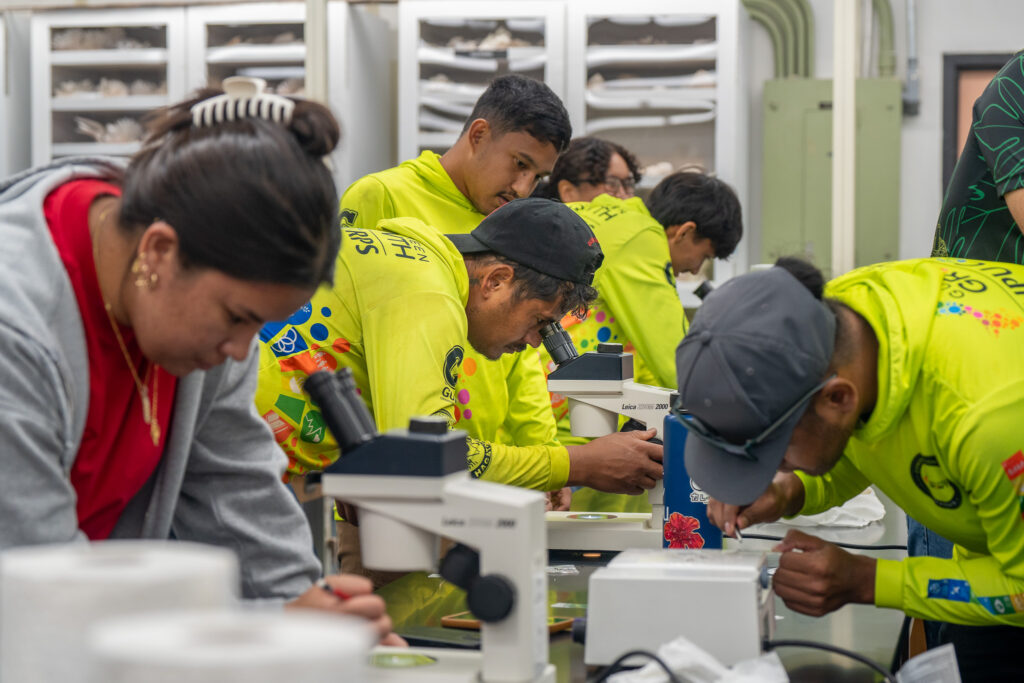
The Guam Green Growth Conservation Corps (G3CC) went fishing for new skills with the experts from the University of Guam Center for Island Sustainabilty & Sea Grant (UOG CIS & Sea Grant), diving into the biological and cultural aspects of sustainable fisheries.

UOG CIS & Sea Grant’s Fisheries division lead the workshop, with Leilani Sablan-Naden helping to guide the G3CC along with way.

“The goal was to demystify life history research, empower community members with scientific skills, and highlight how understanding fish biology supports sustainable harvesting practices,” said Sablan-Naden.

She added, “Each day centered on a focal species or method and emphasized the important role that human behavior, tradition, and stewardship play in fisheries sustainability.”

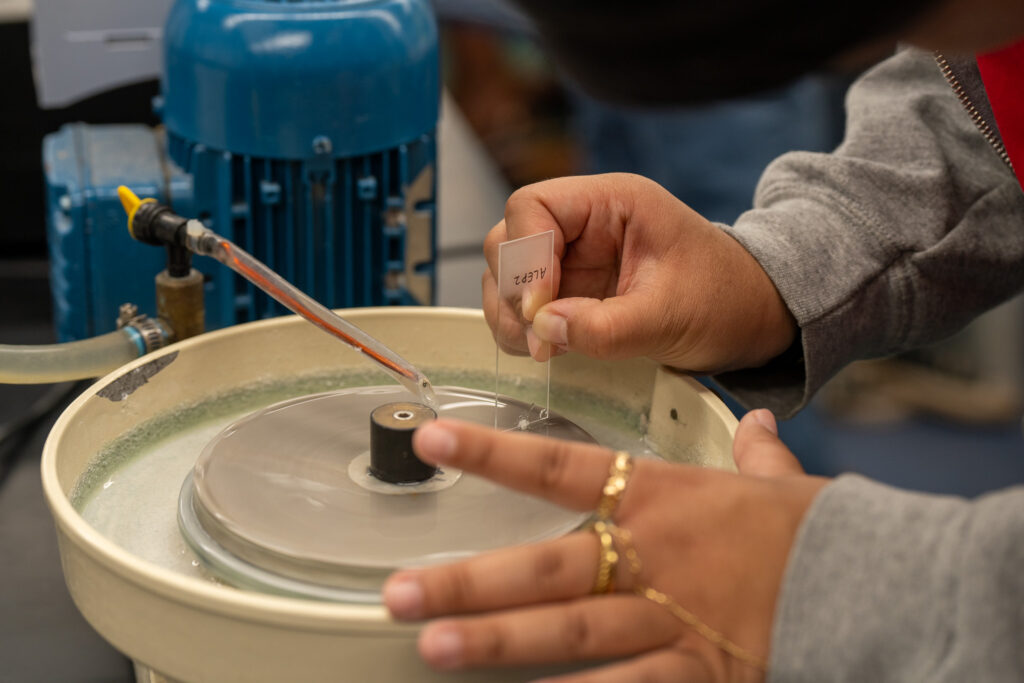
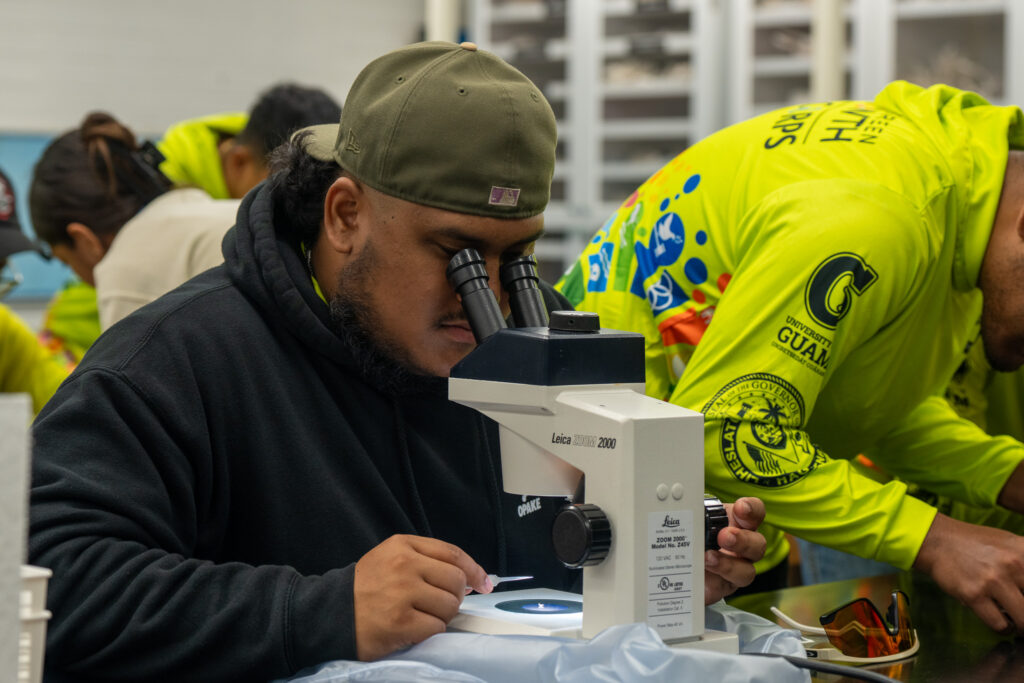
Being a beliver in “learning by doing”, Sablan-Naden set out to teach the G3CC about the concept of life history, which is the study of an organism’s age, growth and reproduction and how this information lends itself to responsible fisheries management.

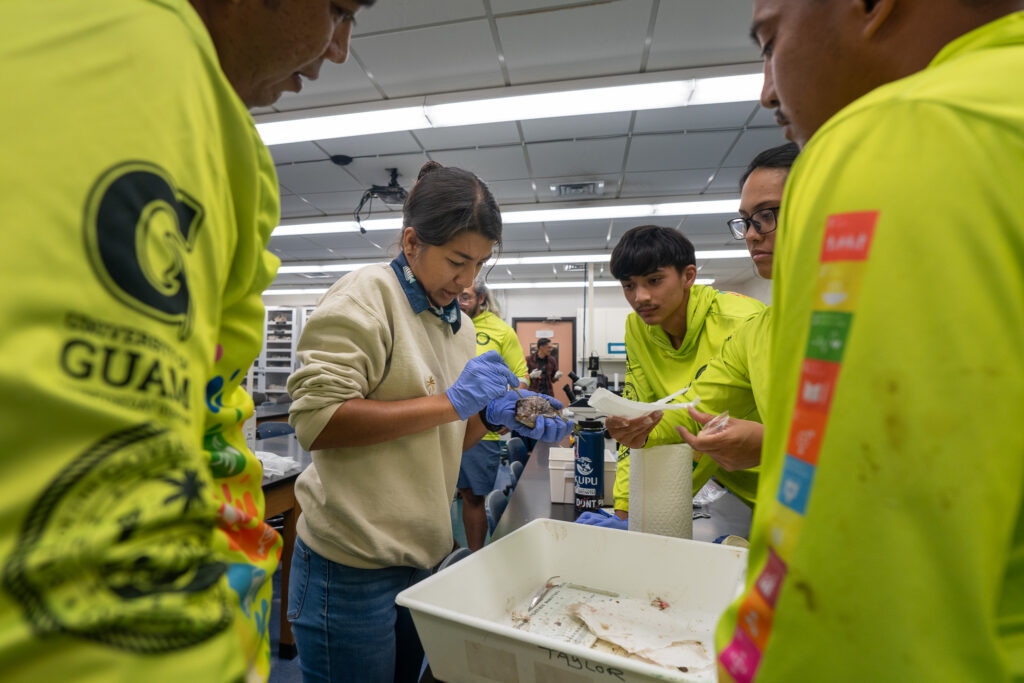
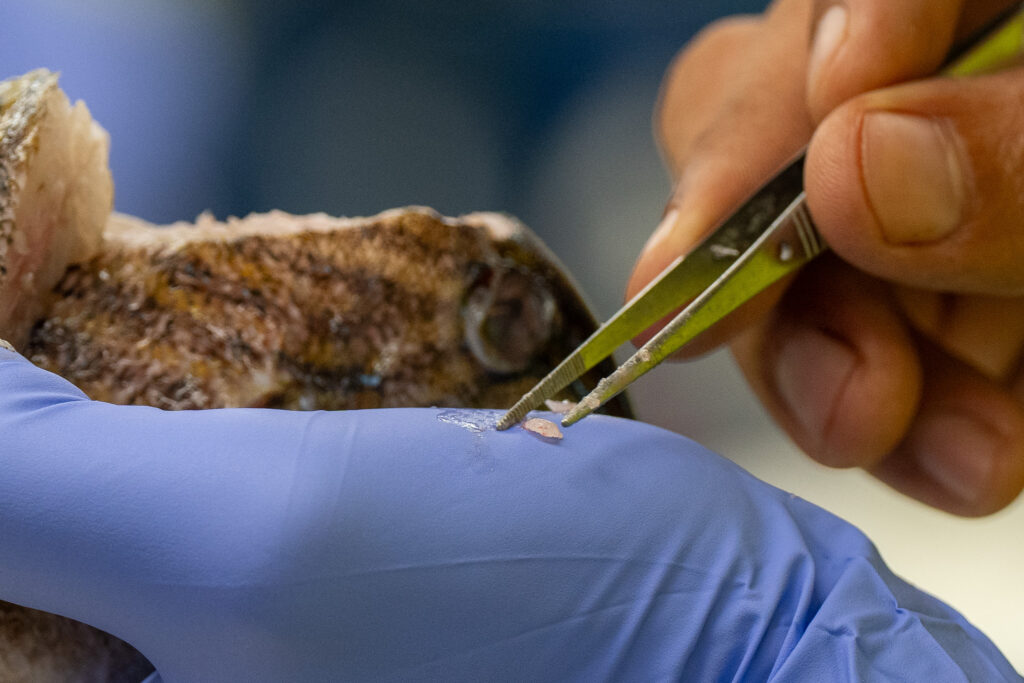
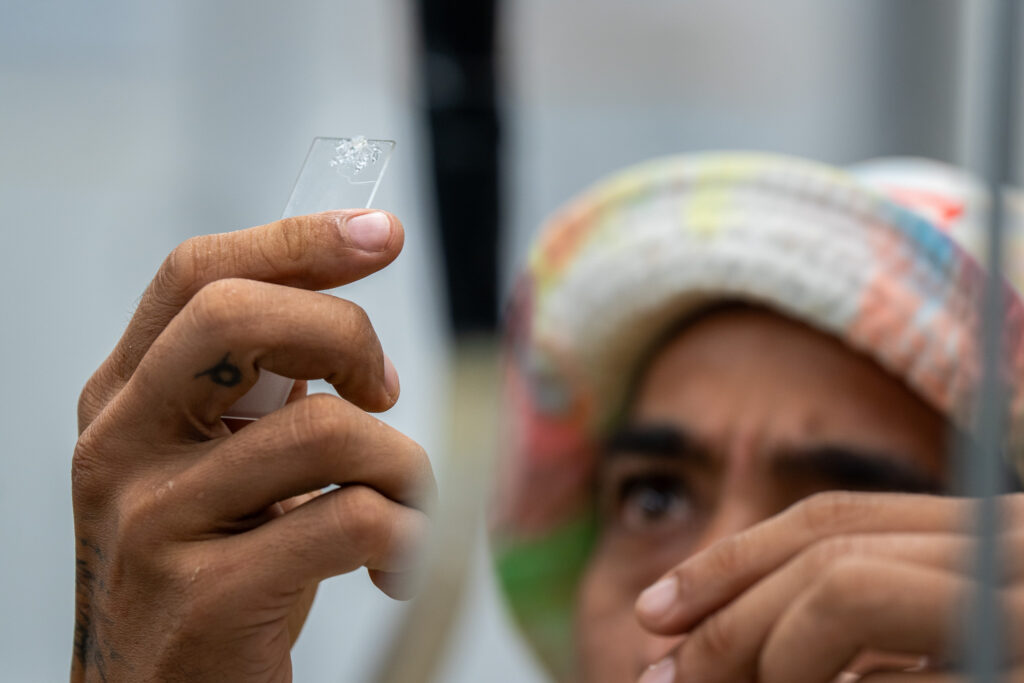
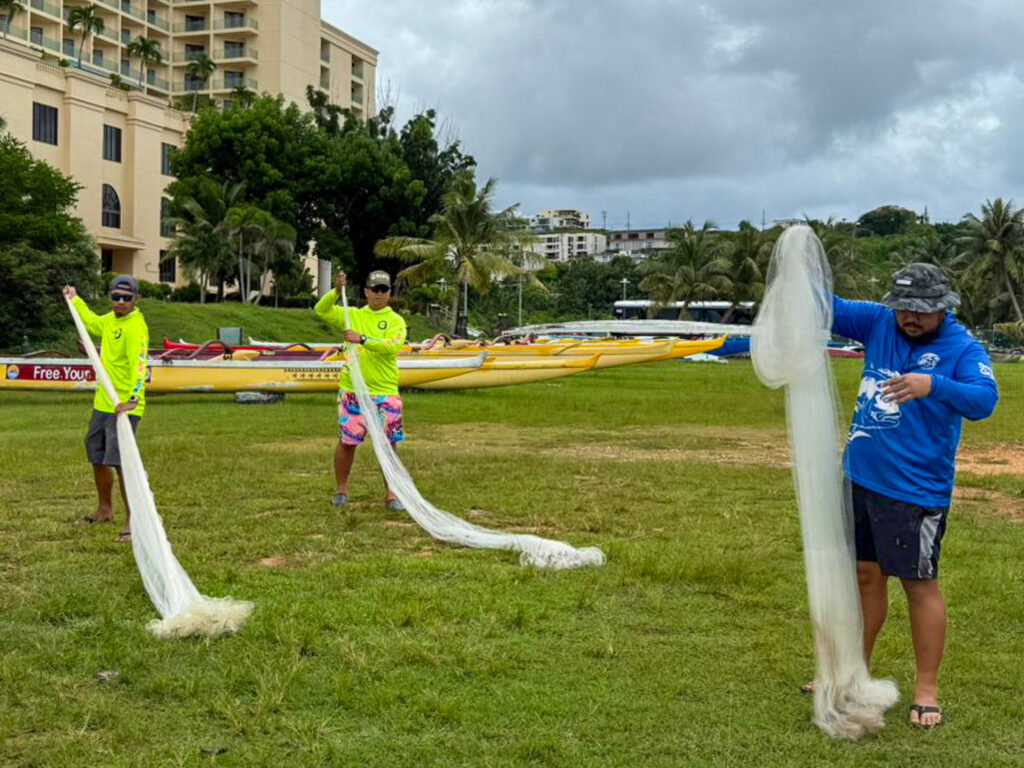
This was achieved through both lab and field work, with with lab activities like dissection of fish species to determine its sex and extracteing otoliths or “ear bones” of fish to determine its age; and field work ranging from learning traditional fishing methods like use of a talåya’ net at Tumon Bay to seeing thriving fish species swimming amidst healthy coral at places like Fish Eye in the village of Piti.

Although these activities are certainly scientific in nature, Sablan-Naden finds them necessary to showcase the accessibility of crucial information regarding Guam’s fish species while also being imperative to sustainability management.

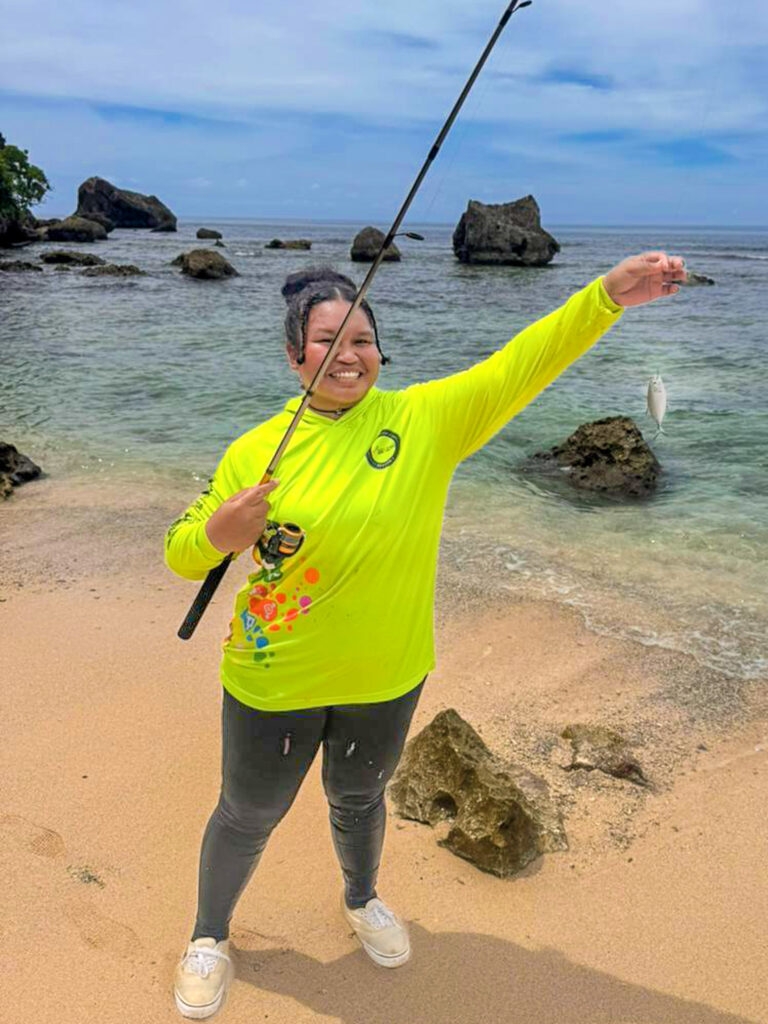
Mi’Yah Max, a member of the G3CC’s fifth cohort participated in every aspect of the UOG CIS & Sea Grant’s week-long fisheries workshop.

Max expresses excitement in having the opportunity to work with the knowledgable and passionate fisheries team. However, unlike her fellows in the G3CC, she approached this week with some hesitation.
She says, “I’m not the best swimmer, so at first I was not as excited for this week like others in my cohort were. That is, until I caught my first fish!”

For Max, in addition to learning about the science and skills of sustainable fisheries, the week was also a lesson in perseverance and courage to try something new.

“Often times people don’t think something is possible for them, until the moment they try and it works out”, she shares. “It was my first time casting a rod and reel, so imagine my surprise when I ended up catching three fish! I am now on the look out for the best fishing rod for my next try.”

As the week with the UOG CIS & Sea Grant fisheries team drew to an end, Max reflected on the lessons learned and its place within sustainability, finding its importance to be even more dire for Guam and other island communities.

She says, “Even if I never go fishing again, I still have the basic understanding that whatever happens on the land affects the ocean, and whatever happens in the ocean affects the land.”

UOG plants over 1200 trees at first GROW in Malojloj event of the year

Uncategorized

The University of Guam’s Center for Island Sustainability and Sea Grant (UOG CIS & Sea Grant), in collaboration with the Guam Restoration of Watersheds (GROW) Initiative, successfully hosted a community tree planting event this past Saturday, August 2, at the Ugum Watershed project site in Malojloj. The event marked the official start of the year’s planting season, drawing volunteers dedicated to protecting Guam’s natural resources from ridge to reef.

The event brought together dozens of volunteers, including students, conservationists, and community members, working to restore the degraded Ugum Watershed.

The ongoing reforestation efforts are crucial for securing soil and preventing sediment runoff, which can harm southern rivers, interfere with the island’s water treatment systems, and suffocate nearby coral reefs.

“We want to thank everyone who came out and did their part to help protect our lands and prevent as much as we can from ending up in our oceans,” said GROW Project Lead Joshua Muña.

According to Muña, his team spent the past several weeks preparing for the event, alongside the newly launched Guam Green Growth GROW Corps.

“The entire team was doing site preparation for the plantings, we started drilling holes for the new trees, and we created erosion mitigation devices with the use of the dead trees that we cleaned up,” added Muña.

Altogether, organizers touted over 1200 trees planted within the three-hour event.

The GROW initiative, part of the larger Guam Green Growth (G3) partnership, focuses on empowering the community to take an active role in sustainable development. The tree planting series is designed to restore the watershed’s badland areas, which have been severely impacted by erosion.

Austin Shelton Ph.D., Director of UOG CIS & Sea Grant, has emphasized the tangible impact of the volunteers’ work. “Planting trees is a tangible way to contribute to the health and resilience of our island,” Shelton told the GROW Corps, adding that every tree planted is a part of a legacy for future generations.

The event also served as a service-learning opportunity for high school students, offering them a chance to earn credits while contributing to an important environmental cause.

The GROW in Malojloj event series is scheduled to continue select Saturdays throughout the planting season, with the next being prepped for September 6, 2025. The organizers encourage families, community groups, and corporate volunteers to join future events and help make a lasting difference for Guam’s environment.

Skip to content